100 Ninja Cats
Existing anonymously
As part of my revelation post-Tomb Raider (2013) I created an excel spreadsheet, as I am wont to do, in order to organize a list of “indie” games to play instead of being duped into another mid AAA game that overstays its welcome. I avoided genres I have no interest in, mainly open world survival crafting games and multiplayer games, and stuck to games released this year that had a good amount of reviews behind them or were posted in the #cool-games channel of the Superculture Discord and looked like something I would actually play. Creating and updating the list has taken up most of my time since the last big post, as well as pursuing the Dishonored idea which I will continue. Some day I will go through and try to provide what no one else has in the past two decades, a definition as to what an “Indie Game” is1. For now, however, games.
I wrote last year about a publisher/developer whose main existence was to propagate trophy bait games on PlayStation. Games that were overly simplistic and existed to provide easy platinum trophies to “trophy hunters,” also known pejoratively as “trophy whores.” 100 Ninja Cats, and the many, MANY, other games in the “100 [X] Cats” series fit into this category, but for Steam achievement hunters. Do those exist?
The flooding of Steam with games is not a real problem. Even less so when it comes to those that exist to provide a hundred achievements in a matter of minutes. The PC’s open platform existence—open to modding, config file editing, and various other tampering—means attempting to create an achievement tracking system similar to the Xbox 360 and PlayStation 3 was never going to work. Some may still take Steam achievements seriously, but by large they are mostly ignored due to the ease of which it is to game the system. This is why I don’t see complaints levied towards games such as 100 Ninja Cats but I do at games such as Milo's Quest on PlayStation 4.
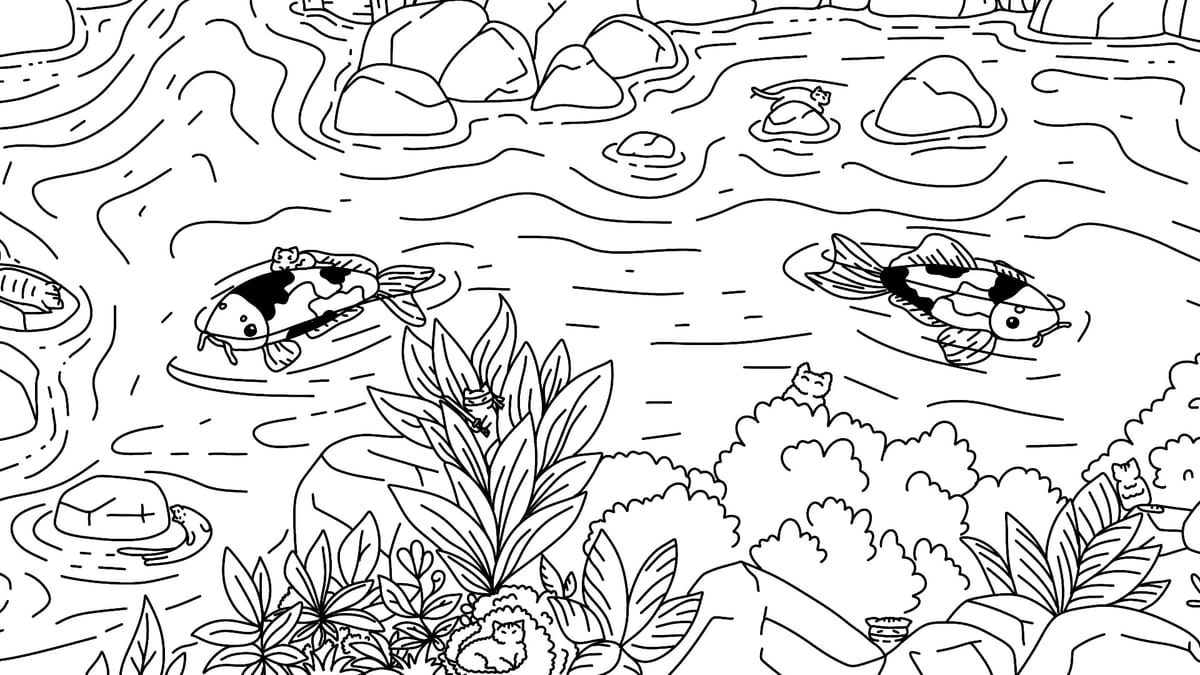
The game, and series, is a cute, simple seek-and-find game where you search through a black and white image to click on cats, which naturally meow when toggled, until you’ve found all 100. Each game is free, with additional images and music being paid DLC. It shouldn’t take much more than 10 minutes to complete an image, and each cat rewards you with its own achievement, hence the trophy bait comparisons.
More curious than the games themselves is the question of who makes them. 100 Cozy Games is the developer listed on Steam and I could find no additional information on them online. They are an anonymous individual or team, pumping out game after game on Steam. As of this writing there are 65 titles, DLC, music, and artbooks available from this developer. This anonymity is admirable in our current online climate. Being free to post and never have to follow up or engage with others online or leave responses and comments that are open to (mis)interpretation.
This was something I noticed when listing out games and their developers: a predominance of usernames in place of legal names when it came to listing themselves online. Pseudonyms were infamously enforced by videogame companies in the early decades of game development to prevent headhunting as well as prevent employees from being able to easily depart due to the lack of a portfolio since it would be difficult to prove you were James Banana who helped make Castlevania (1986). John Szczepaniak did an excellent write up about this for Time Extension: “Here's Why Japanese Video Game Companies Often Didn't Credit Their Developers.”
Japanese companies hated crediting staff and would aggressively forbid it - even going so far as to get another programmer to remove credits before release!
What was once a practice to the detriment of the individual is now utilized to their benefit, namely the lack of a legal name mitigates the ability for the internet to dox and threaten developers they don’t like. Independent developers are much more vulnerable than those working for larger companies that can afford security.2 In regards to any situation like this, it should never be necessary in the first place!
Not that every developer publishing solely under a username is due to threat of violence. Many simply prefer the freedom of choosing their own display name or existing separately from their IRL self. It is very helpful that with hyperlinks, Allmylinks, and social profiles that directly link to other social profiles, publishing titles under a username is now a viable route that does allow a portfolio to be built as opposed to the previous century’s practices.
And so, 100 Cozy Games, wherever you may be and whoever you may be, I wish you well in your endeavor to integrate 100 cats into every scenario in existence. Please don’t be a milkshake duck.
/s, though I will try. ↩
I would recommend The Hivemind Swarmed: Conversations on Gamergate, the Aftermath, and the Quest for a Safer Internet by David Wolinsky for multiple(!) anecdotes from developers about this situation happening to them and those they knew working within development. ↩