49th Parallel (1941)
Directed by Michael Powell, Original Story and Screenplay by Emeric Pressburger
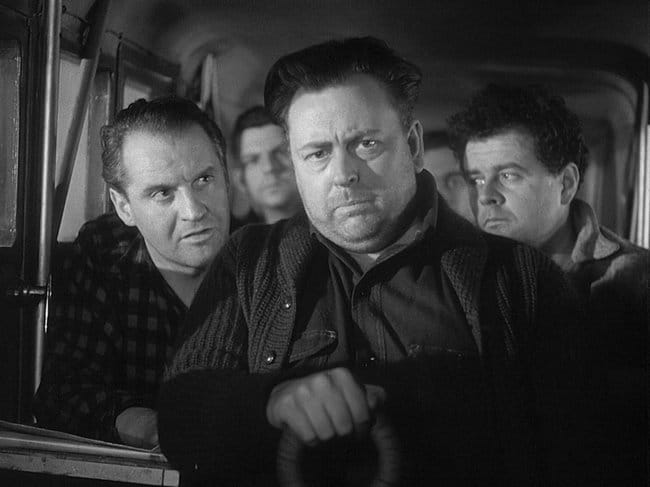
An unsanctimonious World War II British propaganda film. Nazis are on the run in Canada after their U-boat is sunk, attempting to flee to the neutral United States. 49th Parallel is surprising for its usage of Nazis as its protagonists. This position does not inherently make them the hero to be admired, as the evil they believe in and exert over others is quickly and frequently revealed at each stop, whether by proclaiming indigenous and black people as subhuman as the Jews or sadistically prodding a young woman for the details on how her parents were killed by Nazis. Lieutenant Hirth’s insistence on Nazi superiority is rejected and disproved with each encounter. Lieutenant Kuhnecke claims superior intellect to even Hirth but his failure to check the fuel levels of the seaplane results in his death. The Huttites descending from Germanic immigrants reject Hirth’s call to fascism outright. A writer defiantly marches in the path of bullets to prove his kindness, and that of all the people the Nazis have encountered and benefitted from, is not weakness but strength. The Nazis are whittled down to Hirth alone, locked and cowering in a freight car with a Canadian soldier all too willing to violently end this odyssey1.
Alleviating the violence are episodes of comedy. Laurence Olivier plays a French-Canadian with an accompanying accent some find over the top but I find jocular. His humor is matched by the tragedy and defiance in his death. Kuhnecke pleads with Hirth as they plummet into the lake, “Well, I can’t think of everything, can I? I can’t help it if I make a mistake sometimes!” There is a great irony in one of the Nazis breaking cover in a crowd being caused by the penetrating gaze of an indigenous person, as well as Raymond Massey playing a whining Canadian soldier who spouts off about his enlistment, “I’m about as close to getting my hands on a Jerry now as I was at the beginning,” not yet knowing the man he was just sharing a drink with is The Jerry. There is also great irony behind the American version, dubbed The Invaders and premiering in 1942 here, cutting the aforementioned dialogue about the Nazis views on the Other. Speculation tends to lean towards it being cut in order to not offend southern segregationists whose views would be grouped in with and condemned just as the Nazis are.
Hirth’s insistence that the Nazis are warring to “free” the oppressed whites is repeatedly rejected as the lie that it is. His freedom would be freedom from making choices, from complaining, from following their faith, from pursuing work they find fulfilling. The most fervent rejection comes from Peter, the leader of the Huttite community. He is played by Anton Walbrook (formerly Adolf Wohlbrück) who fled his home of Austria fearing for his life due to his heritage and homosexuality. This background information enhances the great monologue he gives in response to Hirth’s attempts to cajole the community into accepting their gospel of Hitler.
Some only came to find new land, new boundaries and a new world, but all have found here in Canada peace, security and tolerance and understanding, which in Europe, it is your Fuhrer's pride to have stamped out. You call us Germans, you call us brothers, yes most of us are Germans, our name is German, our tongue is German, our handwritten books are in German scripts, but we are not your brothers.
Walbrook, as a movie star, was able to afford escaping the Nazis. First to Hollywood where his Austrian heritage stirred rumors of being a Nazi spy and led to his relocation to the United Kingdom which became his new home and final resting place. The Nazi soldier Vogel could not afford escape. He was a baker in Germany for seven years before the war took him away. The Nazi ideology was drilled into him, but his exposure to “the enemy,” his own victims, and the opportunity to once again pursue his life’s work and faith, stolen from him by his own country, breaks through that indoctrination. He is executed for this desertion of doctrine, unable to give any final words before his execution. Vogel best exemplifies the great strength of the film, in its depiction of Nazis as individuals of varying character yet without excusing the great evil that unites them. Vogel as a Nazi could not protest his death sentence, but as a man his quiet execution is tragic.
It is additionally telling that the Nazis only ever succeed through deceit and subterfuge, anytime they come up against an equivalent force they flee or are reduced in manpower by death or capture. ↩