Homefront: Invasion Media, Justified Violence, Images With No Substance
even a rotting corpse can provide food for fertile soil
The following was originally published on my tumblr on June 25, 2023.
Homefront is a strange artifact of the seventh generation of consoles. Its setting is the familiar fantasy of an invasion of the United States by a foreign power and it came from a studio and publisher who would cease to exist less than two years after release. Homefront attempts to present images of horror, and has a desire to ponder whether we are justified to enact horror upon the enemy in return, but this was never going to be the game that ascended its duty to be budgeted entertainment beyond all else.
In Homefront the United States is invaded by North Korean forces and the game picks up two years later as you are recruited into a resistance movement that culminates in joining the US Army for a counter-attack on the Golden Gate Bridge in San Francisco. Homefront joins the likes of many works of fiction engaging with the idea of a foreign invasion of the United States, namely Call of Duty: Modern Warfare 2 and Red Dawn. John Milius, the director and co-screenplay writer of Red Dawn, one of the most famous works of invasion fiction, is credited in Homefront as creator and writer. A later exposé in Game Developer by Leigh Alexander would reveal Milius did no writing work on the game, which was instead largely attributed to C.J. Kershner. It would not be surprising if THQ simply paid Milius for using his name in marketing rather than for any actual writing work.
Why do we so often fantasize about foreign invasion? Invasion literature has been around since the late 1800s, and while the Cold War provided the greatest backdrop, the genre persists to this day and has expanded into video games. A contemporary invasion by a foreign power is not always the choice. Sometimes it is invasion by aliens: Resistance 2, The Bureau: XCOM Declassified, or alternate history takes: Wolfenstein: The New Order/New Colossus, Turning Point: Fall of Liberty. I find contemporary history the most interesting, as it lays bare the motivations and collective feelings of the people both behind their creation and those who play them. In an interview for IGN, Michael Thomsen asks Lead Level Designer Rex Dickson why North Korea and America, Dickson explains, “The reason we chose America and Americans is because—if you look at Eastern Europe, Africa, or Iraq, they’re used to violence. There have been wars in these countries, they’re exposed to it. America is unique in that we have this mentality that we’re almost indestructible. We’re the kings, we’re dominant. We live this life of excess and convenience that most people don’t have. Ripping that away from average Americans is a key theme in Homefront. Of all the cultures on the planet Americans are perhaps the least equipped to deal with something like this. Most people wouldn’t imagine that it could happen, let alone how they would react to it if it did happen. Some of these other cultures are hardened by this stuff and have seen it for years. Americans have almost never seen it, and wouldn’t it be interesting to explore how they would react if it did happen here?”
When the Soviet Union crumbled so too did the universal boogeyman for American fear and propaganda. The specter of the Soviet Union still shows itself within fiction, just look at the Ultranationalist faction of Call of Duty 4: Modern Warfare for that, and while modern Russia remains a favored source for antagonistic forces, just look at the rogue Russian general in Call of Duty: Modern Warfare (2019), Homefront originally picked the other national boogeyman and successor of the Soviet communist fears: China. However, this was an element changed by Danny Bilson, Executive Vice President of Core Games at THQ who had a very hands-on role in Homefront’s development, as detailed by the exposé. Unfortunately for Kaos Studios, China also happens to have the largest market of potential customers. The effect of this market can be felt in many industries, though one of the most illustrative is film, with even the titanic Marvel Cinematic Universe changing The Ancient One in Doctor Strange from Tibetan monk to Celtic woman and Iron Man 3 having additional scenes in which Chinese surgeons operate to remove the shrapnel in Tony Stark’s chest. It is ironic that the remake of Red Dawn released in 2012 also had China as the invading force and was forced to change pre-release to instead substitute in North Korea, reflecting Homefront’s development. Despite these changes, Homefront would sell well but not well enough to save either Kaos Studios or THQ from shuttering within two years, and Red Dawn would be a box office bomb and still not be released in China despite their post-production edits. It is a strange relationship between the US and China, as it is apparent that the US dislikes, fears, and yet relies on the economy of China. This fear is to the point that people fantasize about a Chinese invasion and then realize they need to sell it to the Chinese market to succeed. It is perhaps this reliance that feeds it, an ouroboros of dependency.
There is also, within fiction, the need to position the United States not as the aggressor but as the underdog. This is why with the transition from World War 2 to “modern” warfare, Call of Duty traded the frontline soldiers for special operations. We now valorize those who don’t have access to the excessive force available to the modern army but are instead constantly outgunned and outmanned. Call of Duty 4: Modern Warfare’s segments centering on the USMC had them hopping from one location to the next in a futile effort to locate and arrest opposition leader Khaled Al-Asad. It is the British SAS who end up locating, and executing, Al-Asad, not the USMC. This failure within Call of Duty 4: Modern Warfare is an obvious allusion to the United State’s own efforts to find and capture Osama Bin-Laden that didn’t succeed until 2011. In the modern time the US does not have an equivalent force to face off against on the battlegrounds of fiction. We like to imagine Russia and China have the potential, but the truth is that US spending on military continually outdoes the next ten countries combined. Instead, we either fictionally depower the US through some economic crisis or build up a new opposing force, both of which are done by Homefront. Here North Korea unites with South Korea before annexing, through subterfuge, Japan and other Southeast Asian nations upon which to draw up the manpower required to invade the unstable United States.
Fighting an equivalent force who is the aggressor fulfills two desires: one is that it gives the player a challenge to overcome that also fits cogently within the fiction, and two, it allows us to commit justified violence that we are denied in our real life. I don’t think it is too much of a stretch to claim that everyone has to deal with things they wish they could change in real life but lack the power to do so. We come up against and our feeds are filled with things that we find unjust, but have no ability to circumvent or stop. We also cannot take out our anger against it in a justified way, and so we find different outlets for this anger. Some pick to bully and harass people online to the point of death, others might just schedule an appointment for a wreck room where they are given lease to enact violence they cannot do in everyday life. Engaging in fiction is another outlet for this anger, as we can place ourselves within the mindset of a character who is allowed to enact justified violence against their offenders. In games we get to more actively occupy the role of someone who can do what we cannot. For works such as Homefront, there is also the tinge of patriotism as we get to fight for our country, within the familiar images of our country, though here, as in Call of Duty: Modern Warfare 2, it can mean those symbols of America are a Hooters and White Castle.
We are generally positioned as the victim due to the presumed innocence that comes with being invaded. In our reality the invasion of Afghanistan and Iraq were failures. Having the US invade another country, however justified the fiction may make it, would call to mind too many questions and doubts regarding our own current history. Instead we become the ones whose homeland is threatened. This theme was surprisingly contemplated by developer David Jaffe in his unproduced pitch titled “Homeland” which also saw the US invaded by China but was meant to reflect the US’s own invasion and brutality towards Afghanistan and Iraq. Homefront, however, does not present itself as an expression meant to make the player reflect on the feelings of those whose homes we have invaded in the past. Instead, it is a call to commit justified violence against a brutal enemy.
Games are violent, much more so than any other medium. The amount of bodies you destroy frequently tops those of even the most excessive 1980’s action flicks. Due to this, that excess of violence has to be justified, usually by making the enemy less than human through their actions and disregard for human life and decency. When replaying Fallout 3 some years ago the thought that dominated my mind was the way the Capital Wasteland beckoned the player to reflect the violence present everywhere back onto its citizens, from raiders to super mutants and ghouls. While playing Homefront that same thought came through, especially during the level “Heartland” in which you make your way through a “survivalist” base decorated with human body parts in such a way that reminded me strongly of the raider and super mutant locations of Fallout 3. Places that displayed such a level of horrific dismemberment that you would never think twice about committing such acts yourself. Here, in Homefront, it assuages the players’ consciousness that, while you are fighting fellow Americans, they are less than the citizens of the America you are fighting to liberate. They are less than human, haven’t you witnessed their brutal acts of killing for sport and fun, of executing captured soldiers and lamenting that they won’t have anything else to do during the day? Squadmates comment on the brutality and how while they also hate the invaders, they would never debase themself to this level of violence in retaliation. The Korean People’s Army, or KPA, are also very violent figures. Their oppression of Montrose, Colorado is on full display during the introduction, which uses the sit and look mechanic of exposition made famous by Call of Duty 4: Modern Warfare. The KPA abuse and kill, force those who remain to live in squalor, and respond to their losses by bombing an entire city. Homefront beckons the player to reflect this violence back onto them, through not only violent resistance but also through immoral weapons like white phosphorus.
Similarly to its appearance in Spec Ops: The Line, white phosphorus is a horrific weapon whose appearance brings into question the morality of whoever is using it. In Homefront it is the resistance member Connor who obtains and orders the usage of white phosphorus rounds during an assault on a fuel depot of the KPA. It appears in an earlier level with comment from your more level-headed resistance member Rianna (whose status as a woman is thankfully affirmed by her bare midriff amongst the fully covered men) who questions the ethics behind its usage. Connor is an angry man, someone who has been radicalized by the KPA’s actions and has no qualms about using every means available to reflect their violence back on them. He justified the phosphorus rounds as the KPA was going to use the weapon against their people, so why not do it first?
The first mortar round ignites a wide area, leaving enemy soldiers to walk around screaming and burning. A second round misfires and nearly kills you and Rianna. Connors comments lay bare his intense hatred of the enemy, such as burning soldiers being met with the retort, “Thought I smelled Korean BBQ!” Rianna’s counters are supposed to balance out his attitude underneath the guidance of their leader Boone. However, returning from a mid-game mission you find Boone dead and the Oasis, a retreat hidden amongst the suburbs in which the resistance lived in peace, destroyed. This could be the moment Rianna becomes radicalized like Connor. Were this a better written game her radicalization might have been explored. Perhaps she would become even more extreme than Connor, or reconcile her anger with the universal injustices war brings about. Instead we only get the few dialogues I can draw this potential from, as the rest of the game progresses without much mind given towards this arc. Sadly it exists more in my mind than in reality. Connor sacrifices himself in the end, allowing the US military to drop bombs on an approaching convoy of KPA vehicles to secure the Golden Gate Bridge, bypassing having to answer the question of whether his methods, anger, and willingness to commit any act of violence in the name of resistance was worth the victory. To Connor the answer would be yes, but no one else gets a chance to speak.
Not only does Homefront fail to engage with the themes of violence but also frequently fails to sufficiently present images of violence. Throughout the campaign you will be presented with images of horror that, while depicting horrible things, fail to have substance or texture to them.
There are some effective images in the game. Early on you witness a mother and father executed as their child cries. After, the soldiers walk away and leave the kid to tearfully walk to the bodies of his parents. It’s cheap, like killing the dog, but still effective at evoking revulsion and sympathy. Later on you will ascend a treehouse, a symbol of childhood, which is subsequently blown to pieces by the KPA. The visual metaphor is a bit heavy handed, but again, effective. Lastly is when you encounter a community of survivors living on a cul-de-sac of single family houses, the epitome of the American Dream, and end up having a firefight within them. At the outset a mother and her screaming baby are trapped in the same house as you. Having a screaming baby cry as you kill enemies in the front yard of an American suburb is something I don’t think I have ever played through or will again. Michael Thomsen for IGN’s preview of the game felt much the same way, “I felt like I’d made a horrible mistake drawing the Korean attack into this woman’s home, imperiling her and her child without any benefit to them. They weren’t fighters or rebels, and my reckless scramble across the city was costing them the remnant shelter they had kept for themselves.”
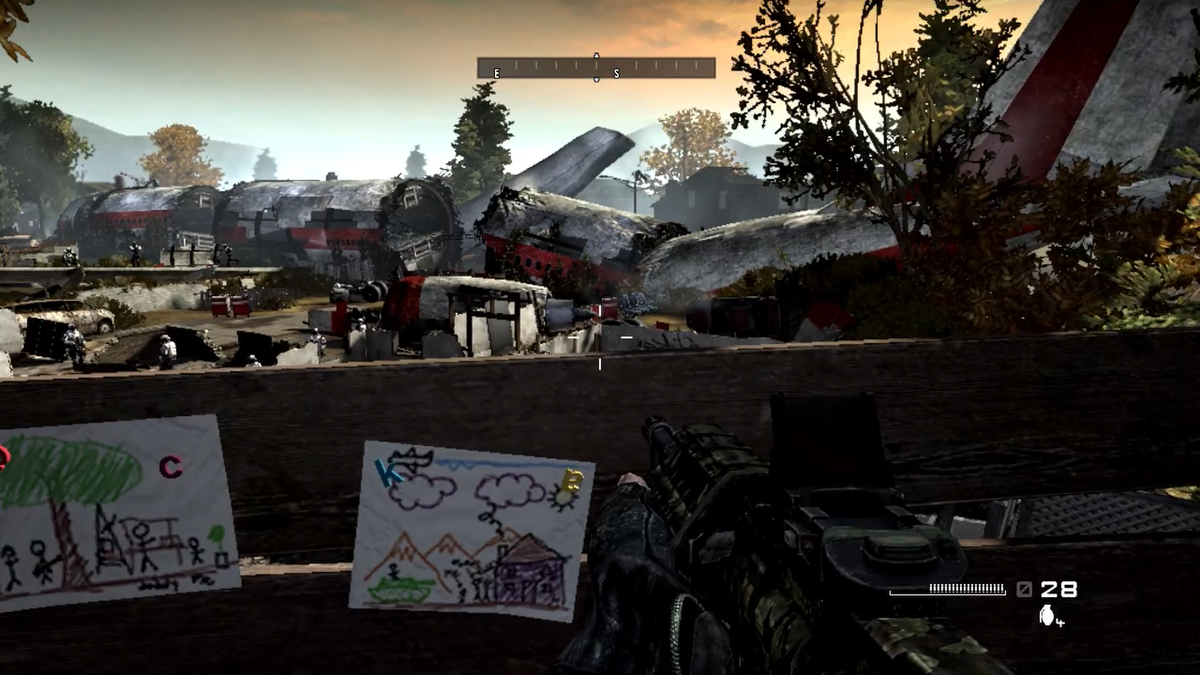
Homefront’s obsession with American images extends to the innocence of children, as throughout the first half of the game you are presented with the destruction of their innocence by the KPA again and again. The parents executed in front of their child, the destruction of a treehouse, a baby amidst a firefight, sleeping toddlers and a baby in the resistance Oasis base, the sounds of children playing just out of sight, waking up to drawings of children taped to the bottom of the bunk, moving through an emptied school, and a mother wailing as a child coughs within the labor camp. It never commits to showing violence enacted directly upon children, as when you return to the destroyed Oasis later the only bodies are those of adults. Children are the epitome of innocence and purity, and the image of their constant destruction at the hands of the invaders is another way the game beckons and justifies your violence towards them.
An area in which Homefront fails to have the dramatic effect intended was in the mass gravesite you discover. Within the baseball field’s diamond (yet another twisted image of Americana) the KPA have been digging mass graves and filling them with the bodies of those within their labor camps. The sight of it enrages Connor, and later you are forced to hide amongst the bodies in order to avoid detection. The moment is supposed to be horrifying in both that a mass grave by itself is a horrific sight, but also that you are now amongst the bodies and cannot cry out for fear of discovery. Hiding amongst the dead is not a new act, but video games lack the texture or care required to sufficiently render the horror of it, especially budget titles such as Homefront. When white phosphorus is used it fails to capture the real terror of it, the heat, the smell, the damage it can wreck on a human body even when not fully engulfed as is so often depicted in games. I remain steadfast that games do an injustice in gamifying weapons such as these. Their acceptance erodes what we are willing to give over to thoughtless entertainment and undercuts the severity of their real life use and consequences.
Homefront stumbles not only in depicting a horrific occupation but also in emulating the type of game it is clearly modeled after: Call of Duty. It was not until the final mission of the game set against and on top of the Golden Gate Bridge in San Francisco that I felt the thrill of virtual combat take hold. Homefront lacks the funding afforded by Activison and therefore falters in both moment to moment movement and feel but also in spectacle. Even here at the final hour the limits of the budget shine through, as the landscape of San Francisco is clearly a flat image. A sufficient matte painting backdrop for a multiplayer level in Call of Duty, but not a very impressive landscape to view as the helicopter rides into battle. Their vehicle mission in which you pilot a helicopter yourself and escort some tankers is painfully slow paced but a relief from the even slower stealth sections of the mission prior in which you simply sit and wait for the companions and game to both tell you when exactly to pull the trigger. Most of the game is following Connor and occasionally pushing square to enact canned animations. Even the ladder climbing is something you don’t control but instead just watch after engaging. John Walker for Rock, Paper, Shotgun would go so far as to say, “Homefront is barely a game. I’m drawing the line here. It’s an interactive cutscene with occasional shooting galleries.”
This is the sort of middling game from this generation that I have a morbid curiosity in and am somewhat happy to finally play. As a game it isn’t very good, as a work of art it is at least a text that I can draw various readings from. As an entry in the first person shooter genre I think it fulfills the role of generic shooter you might see played in the background of an episode of any network television drama for a few seconds. A fitting metaphor for Homefront is that even a rotting corpse can provide food for fertile soil, and while many readings are provided by this text, it remains a work whose meaningfulness is found as a subject to dissection.