Notable Things in 2024
There will be spoilers for all topics discussed
Welcome to the end of the year. I cannot continue without acknowledging that while you and I have made it to the end of the year, there are many who have not and many more who have in conditions we should not allow to exist. The ongoing genocide in Gaza has weighed heavily on me all year. Instead of speaking on it I have donated to try and help out and would encourage others to do the same using this helpful spreadsheet.
Looking back at the year for myself, the individual, I was called back to a previous job with better pay and significantly less stress which has been beneficial for me and my family and I have much to be thankful for. I’m happy with my output in terms of writing, even though I never put out as many videos as I would like to. It is very difficult to find the time for video editing amongst all the other responsibilities I have.
My favorite things I’ve created this year are: The Bodies We Leave Behind, MONTHLY ‘ON CULTURE’ MISSIVE - JUNE 2024, How Does Rogue Warrior Fare as an Adaptation of Richard Marcinko?, Dishonored Step by Step Part 1: Dunwall Tower, and Games Media in Review: Noclip. With the bravado complete, here are what I found noteworthy in the year 2024 with honorable and dishonorable mentions at the end. Here is to 2025 and the end to war everywhere.
Videogames
Alan Wake II: Night Springs & The Lake House
Night Springs is the victory lap Alan Wake fanfiction whose highlight is Rose’s episode with her gun room, blood splatter prayer, Alan talking through the singing bass and deer, and Mr. Scratch becoming a melodramatic werewolf biker. The Lake House is the more serious session of getting back into the style of Control with its FBC redacted documents, key cards, FMV projectors, while also incorporating the light shifting mechanic from Alan’s segments of the main game in small ways. I came to The Lake House late and was a bit worried that the “Control 2 tease” was going to be MCU end credits bait but thankfully not what happened. I enjoyed seeing Dr. Darling again, Matthew Poretta simply oozes school boy/golden retriever energy. It also fulfills the Remedy Law: playing any Remedy game makes me consider replaying their entire oeuvre again. The Lake House introduces two new characters for you to hate and work towards killing, alongside a tragic tale of a painter in their custody. I did not expect an email chain regarding nut allergies and pies to build up such malice against an individual to the heights I reached.
Caves of Qud
The 1.0 release of Caves of Qud is the perfect savior to a lackluster year. Qud is terrifyingly large, the kind of volume and mass comparable to Chtulu driving people mad in their incomprehension of it. Qud is a game I have now spent 30+ hours playing and yet have probably only grasped 1% of it. A true rogue-like with no carryover progression for classic mode characters besides your own knowledge retention. Even the more forgiving checkpointed roleplay mode can be as defeating upon death. Knowing you won’t be able to replicate that run that ended in an overconfident commitment to the fight that saw you instantly vaporized, digested, slaughtered, and otherwise killed off makes you consider permadeath a more forgiving consequence. Following the game for a couple of years it has been fascinating to watch it change through its time in early access, the kind of growth that makes me look up old videos of gameplay in order to confirm my memory of how things used to look. Unlike Cyberpunk 2077, a game whose updates acted as a pitcher to knock off unwanted material, Caves of Qud emerged fully formed from the sea and its updates have only continued to beautify it. How it has only accrued 8,278 Steam reviews as of this writing over its nine year existence is wild. Qud is a thrilling adventure game that continually sees me venturing into its wilderness just to see what I can find. It is that kind of “emergent narrative” game I rarely actually find within the field.
Cyberpunk 2077
My first run at Cyberpunk 2077 was upon release and for about a month afterward. Ending in a little over 30 hours spent attempting to make sense of what the heck the developers of Witcher 3, a game I really love, were doing or trying to communicate in this game. The advertisements are obscene (derogatory) and the open world, inventory management, skill system, and icon littered map were overwhelmingly white noise drowning out whatever might be worthwhile. Now, coming to it again after the 2.0 update and another 30 hours, I think I see their vision more clearly. The noise still exists: I hold all systems that include miniscule percentage differences in skill upgrades and equipment in contempt. The clutter has been reduced, both at street level and in the overworld map. It helps one pay more attention to the bespoke writing for side bizs and missions. Pretty much all are mini tragedies told through texts you find on dead bodies. This is a trend in most open world games, as creating living people requires much more work than leaving a hundred plus dead bodies for you to loot through. The game also falls into the same open world trap of everything that happens only happens because you did it. Nothing happens without you and you never get interrupted or sent to a job. You decide to trigger it. Your character is doomed to die but you can pass months without any consequence. My compulsion to mark off the map’s icons is no different from any other open world game, but there is occasionally enough writing within the otherwise formal template that makes it more worthwhile than another Far Cry and is a necessary checkmark to accomplish prior to the, by all accounts improvement, Phantom Liberty expansion.
Doom 3 (Supplemental viewing: The Doom 3 Shotgun)
I acted upon one of my hyperfixations and finally started up the original version of Doom 3 on PC. It is VERY different from Doom 1 & 2 and the reboot of 2016, but I like that they really went for something different from the expectation and turned this into a horror game. Sure, there is still a lot of action and it follows the standard ascension of capabilities that neuters the scariness in the long run. On the harder difficulty enemies still hit hard enough that getting jumped by an imp or being swarmed by whatever the fuck those head spiders or scampering flesh monsters are is still a rush hours after they are first introduced. This is mainly attributed to the lighting. Many sections are impossible to see without your flashlight, a tool that has to be swapped to and from and cannot be handled at the same time you are holding a weapon. This is the cardinal sin of its BFG remake and why I intentionally sought out the original release rather than the one put forward first when searching for it presently. The intention behind forcing you to pick between being able to see and being able to shoot greatly enhances the tension of walking into a new, shadow drenched room. The duct tape solution introduced in its “enhanced” edition absolutely cheapens the atmosphere and vulnerability felt.
Books
A Simple Soul & Madame Bovary by Gustave Flaubert
A few years ago when reading How Fiction Works by James Woods and Terry Eagleton’s Literary Theory: An Introduction, Flaubert was one of the most mentioned authors whose works had great influence and admiration. During a reading slump I read three of his short stories: The Legend of Saint Julian the Hospitalier, A Simple Heart, and The Dance of Death. Of these, the life of Felicite in A Simple Heart most touched me. The chronicle of the many people encountered, their deaths, and ultimately her own passing was tender and moving. When I first started Madame Bovary it took some time to get adjusted to Bovary’s point of view. Her dissatisfaction with life was a hurdle that eventually became the central pillar. I have long acknowledged how people in comfortable positions of life would be much happier if they only realized how well they had it. Bovary is a tragedy of someone incapable of finding any happiness within their own life and it destroys their entire family in the end. It is utterly deserving of its reputation.
Dead Men Walking by Steve Lyons
It has now been nearly two years since I started embarking on reading Warhammer 40,000 fiction and this book, much like Dan Abnett’s Hereticus from last year, will stick with me for a long time. The book tells the tale of three characters from different classes and their involvement in the emergence of Necrons (space egyptian robots) in their hive world (think Coruscant from Star Wars but more miserable and polluted). The central pillar of 40k includes the lines, “To be a man in such times is to be one amongst untold billions. It is to live in the cruelest and most bloody regime imaginable,” and this book exemplifies that. Each character is insignificant on the planetary scale and none receive a desirable ending. I thought Hereticus was a feel-bad book but this takes it to an entirely lower place of despair.
Perfidia by James Ellroy
The most peculiar aspect of Perfidia is that it takes longtime Ellroy boogeyman Dudley Smith and attempts to defang him. Smith was an easy to hate villain of the first LA Quartet and Perfidia is the beginning of a second. Perfidia makes him a point of view character alongside the Asian-American chemist Hideo Ashida, thrillseeker Kay Lake, and a fictional version of the real life individual William H. Parker, future Chief of Police in LA. Each non-Ashida character has an enlightened view of race and communism, a characteristic of Ellroy’s later era characters. They now include Smith, previously highlighted for his racist killing of a Mexican in The Big Nowhere with a zoot stick. Perfidia is littered with characters, both real and fiction, from his later work, so much so that the back of the book even contains a dramatis personae listing each and where they appeared. Smith is defanged by his love of Bette Davis, who easily rebuffs the trademark detective lay. Smith soon finds solace from Davis’ spurns in Claire De Haven, a communist also appearing in The Big Nowhere. Ellroy’s depiction of communism in The Big Nowhere was one of scam artists fleecing a cause for their own social and financial gain. This evolved into a viewpoint much more sympathetic and most prominently over the course of his Underworld USA trilogy, his magnum opus. His growing softness for the reds is still present though more restrained in Perfidia, as Smith and Claire’s relationship is built on the excitement each brings to the other's life with their opposing careers and Claire remains uncommitted to the actual cause and more attracted to the social standing within the in-group. All of this is derailed by the truly wild decision to have Smith be the father of Elizabeth Short aka the Black Dahlia. It is offhandedly introduced, is restated many times, and even has her appear in person late into the plot. Ellroy frequently ties together his fictional characters with those of real life historical figures, often to mock and belittle them long after their death, but this is a step beyond. The usage of Parker as a point of view character is also very intriguing due to this being the first time Ellroy has utilized a historical figure as a point of view character in his books, which brings into even greater scrutiny the difference between the way he writes his characters internally and the facts we have of their external actions. Perfidia fails to convince me that the Smith and Parker we see here are the same people seen in the chronologically later writings and reality. It is only the first of his new quartet, but I don’t have much faith or interest in redeeming Smith as a character and would much prefer a greater understanding behind the mechanics of his mind that makes him aware of the idiocy of eugenics but remorselessly shoot and kill a random Japanese citizen at the behest of a sleeping Bette Davis.
Films
Days of Heaven directed by Terrence Malick (Supplemental reading: Subvert Normality: The Streetwise Voice of Linda Manz)
One of the films that was watched thanks to the conversation between Gene Siskel and Roger Ebert. just as beautiful as you may have been told. A biblical parable of deception and the resulting destruction complete with a plague of locusts.
Heaven’s Gate directed by Michael Cimino
The box office bomb that ended a director-led era of film production gave way to the growing IP domination of the 80’s that we are still subjected to today in repeated loops. Not fully the fault of Cimino given that the film released in theaters was a re-cut dictated by United Artists. The film, as it exists on the Criterion Channel, has moments of immense beauty and of brutal violence. Immigrants are being routinely killed in vigilante justice as the scapegoats of all of society’s ills. In spite of this, they still find time to dance and celebrate. They also unite together to drive off their would-be hangmen, who are funded by a high class gentlemen's club of Harvard graduates. They succeed to the point that the US Army has to appear, not to bring justice, but to stop the potential victims from turning the tables on their executioners. It leaves Kris Kristofferson forever disillusioned with America and its values, even as he benefits comfortably from them.
Picnic at Hanging Rock directed by Peter Weir
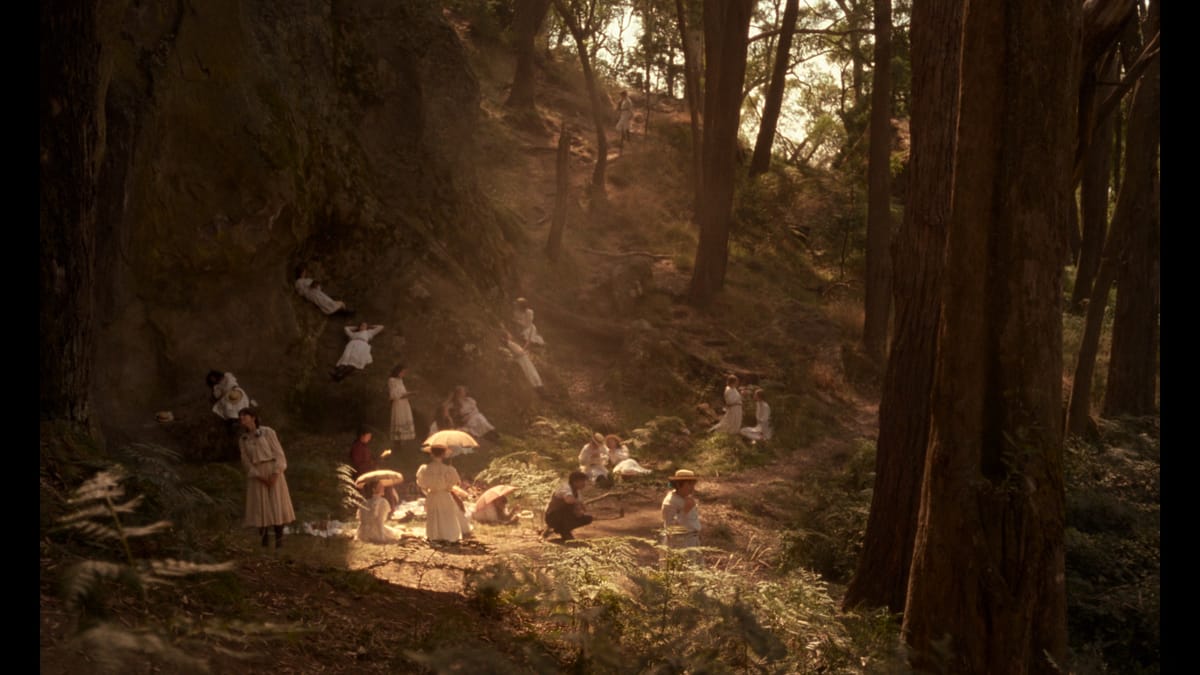
By far the favorite piece of art I had the pleasure of experiencing for the first time this year. A haunting picture about three young girls and a schoolteacher from Appleyard College who are swallowed up by the land. The horror of it is that there is no answer. People give their theories, and one girl is even miraculously recovered thanks to the obsession of a young boy on vacation. This only leads to more pain as the rest remain missing, never to be found. There were no hats or gloves for anyone but Edith, who constantly complained. Her unwillingness to bend or be open is why she is left behind. Miss McCraw has the appearance of uniformity but inwardly is more open and likely why she was taken. She was transfixed by the rock before they even arrived. There is a period of investigation, opinions and theories. All exhausted with no solution. Michael is drawn to the rock, overcome by it. Albert finds him and then Irma. It is the quiet downfall of the cop and Appleyard for failing to find and keep safe the missing individuals. On my rewatch I was mainly concerned with the tragedy of Sara, the tragedy of her passing and Albert's unknowing proximity to her. Never reuniting save for her appearance in his dream the night of her death. Education forces students to mold to their ideal image regardless of a student's own unique capabilities and creativeness. We see this as Sara is shut down from reading her own poetry in favor of memorization of another's. Sara's tuition is overdue, withdrawals and missing girls means no more income. Appleyard could easily become cruel but has to reassure herself of what she is going to say to Sara due to the lack of tuition payment because it is difficult for her and so she falls into drinking. With Miranda gone Sara has no one to give compassion or grace. Shame of Appleyard over the missing and Sara's suicide drives her to the rock for redemption but only finds death. Sara, without Berty or Miranda in her life, and unable to reach the rock herself most likely, chooses death over going back to the orphanage. Just a sad and beautiful picture. Truly haunting.
Addendum: Picnic at Hanging Rock by Joan Lindsay
The ability of the novel to allow a reader to inhabit a character’s internal machinations only enhances the feelings present in the film. The warmness between Albert and young Michael. The tragedy of Sara further supplemented by repeated avenues of escape hanging just out of reach. The charm of Michael’s uncle, and the ruthless attitude of Headmistress Appleyard. The novel is very effective at convincing one that it is a factual recounting of a historical event. It's cold, casual mentioning of plain facts of fates of its characters showcases author Joan Lindsay’s ability to build care for even the most tangential of characters.
Thief directed by Michael Mann
Another delightful first viewing. The score, the scenes of a professional at work, contemplating whether James Caan’s character ever really wanted a peaceful life or if it is just another empty idea of something that would make one feel complete and happy. This is such a complete picture and yet somehow Mann’s feature film debut.
The Long Good Friday directed by John Mackenzie
Everyone in business has already made up their mind to say yes or no long before the expensive and lengthy schmoozing process has begun and there is nothing you can do to convince them to accede to your wishes. Pierce Brosnan in his very first film role as an IRA seducer. Bob Hoskins in the lengthy, erotic shower scene wiping the blood of what was once a close friend. And the final shot of Hoskins’ face, experiencing what you could call the five stages of grief for his own impending death as the end credits begin to roll and the camera holds on him at length.
The Maltese Falcon directed by John Huston
I love noir despite never watching enough of it so I am glad to plug this blind spot. Following along with Criterion’s “Noirvember” I had seen Bogart in They Drive by Night and High Sierra and this served as the natural evolution of his on screen persona into the man we remember him as today. Multiple scenes of talking but the underlying potential of violence makes each conversation tense and it perfectly captures the “trust no one,” ethos of noir/detective fiction.
Henry V (1944) directed by Laurence Olivier
I never cared much for Shakespeare but this performance came recommended by Susan Sontag and I became quite taken by the midpoint, where Henry declared,
I pray thee bear my former answer back.
Bid them achieve me and then sell my bones.
and it fully enveloped me with:
I was not angry since I came to France
Until this instant. Take a trumpet, herald.
Ride thou unto the horsemen on yond hill.
If they will fight with us, bid them come down,
Or void the field. They do offend our sight.
If they’ll do neither, we will come to them
And make them skirr away as swift as stones
Enforcèd from the old Assyrian slings.
Television
Sneak Previews (1975-1982), At the Movies with Siskel & Ebert (1982-1986), Siskel & Ebert & The Movies (1986-1999)
I wrote about Siskel and Ebert’s movie review shows early this year, but I have continued to watch and enjoy their discussions of film throughout the entire year. I am currently in their early Buena Vista Television days during October of 1986. It is a real tragedy that these shows are not better preserved and available for viewing. There is a real problem with the here and now being prioritized over all else. This was noticed by people such as Zach Schonfeld for Newsweek in 2017 and as evidenced by Scott Collura of IGN following up with no substantial improvements made as of earlier this year. The movies being discussed and the discussions themselves are timeless and it is shameful that the preservation of their conversations falls on the goodwill, hard rock, and luck of those who have tapes and digitize them for YouTube. Their Buena Vista days condenses their discussion time even more with a section dedicated to the recent home releases. This can be assuaged by the home releases being movies not previously discussed, but more often than not they are movies covered on the show and therefore becomes each repeating the same things they already said the first time. This is fine when it's a wrap up of the year, but week after week it can only feel like it is stealing away from the main conversations about the movies fresh in their mind instead of echoing back old comments again. Nevertheless, they have reinvigorated my appetite for film and delivered many new titles to my watchlist I would have otherwise overlooked.
Law & Order: Criminal Intent
The two reasons I started watching this was Vincent D'Onofrio is a great actor and I had heard that this Law & Order drew much from Sherlock Holmes, the formative fictional character of my adolescence. I’m always interested to see adaptations of Holmes, from the explicit likes of Elementary with Jonny Lee Miller and Lucy Liu (my personal favorite of any contemporary adaptation) to the more implicit likes of Psych and House. D’Onofrio utilizes his large frame in a unique way that is not quite intimidation but more curiosity in the suspects' possessions in order to unease them. The “Goren lean,” is a fun little quirk of the character, as is his penchant for disguises (sadly rarely utilized), and he has the same type of encyclopedic knowledge of esoteric topics that Holmes would utilize in unlikely ways to gain information and insight. It is Law & Order and so enjoyment will be based on your tolerance for copaganda and the series has a significant decline post Season 4. Jeff Goldblum injects some needed energy but the show itself wraps up in a shortened season 10 bringing back D’Onofrio and his eternal Watson, here in the form of Katherine Erbe’s Eames who sadly is never given much to do, especially when compared to Lucy Liu’s Watson in Elementary. I want to do a larger Billiam style video covering the entirety of the show and have started work on it, though it will require a detailed rewatch, spreadsheet open to count the leans, the confessions, and the actors who guested and went on to become big.
YouTube
Essays
Whitelight (Supplemental viewing: Raycevick’s Ubisoft Isn't Bad... It's Infuriating)
You can reductively classify the “YouTube long form video essay” into those that are just a lengthy and unnecessary plot summary with occasional, “that was cool,” or, “That was annoying,” (your The Salt Factory types), and those who actually have something to say. Whitelight is the latter. Despite covering a lot of Ubisoft games, a genre I have nothing but contempt for, I still find Whitelight has actual things to say beyond superficial comments and judgements to pass.
choops: Berwick Saga is NOT Fire Emblem
This video was my first exposure, like many others, to choops. The front is so heavily and fantastically edited that I can’t help but rewatch it anytime it comes across my feed. This gives way to a less heavily edited, but by no means less labor intensive, discussion of the game itself. choops has an effortless authority over the mechanics of the game, which I appreciate from an arm’s length as someone who is more narratively inclined when it comes to videogames.
RedLetterMedia: Best of the Worst: Halloween Spooktacular 2024
RedLetterMedia is a perennial recommendation. One of the longest and most consistent channels I’ve enjoyed, their annual Halloween video is always one of their best thanks to Rich Evan’s sets, the movies chosen, and the discussion. This year features Jack Quaid of The Boys fame, and he fits in very well with the crew. Jack’s obviously a fan of the channel and I’m very jealous that he is living the dream of showing up for multiple videos AND also appearing on an episode of Strange New Worlds, the only worthwhile Star Trek media to release since Beyond in 2016.
MandaloreGaming: Cabela's Dangerous Hunts 2011: A Cursed Hunting Game
Mandalore’s videos are your IGN breakdown box of segmenting portions to specifically talk about the graphics, sound, gameplay, story, and frequently include a prelude of, “how I got this working on modern computers.” Their skill lies in transcending beyond the superficiality that has historically plagued that format. With a combination of humor and a willingness to be open to whatever the current subject might be trying to achieve, every Mandalore video becomes worth watching. It is also very helpful that he avoids the verbose length of most other videogame YouTube channels.
Warlockracy: Fallout 1: Real Theory Hours
Warlockracy, similarly to Mandalore, fulfills the role of “plot synopsis” but with much more insightful points than any of the others in that category. Their comment on Fallout (1) sticks with me the most
It is with a heavy heart that I must announce that not only are videogames art, that by itself would have been manageable, but the classic role-playing games, specifically, are our equivalent of high art. And the signs are everywhere. People seem to believe that these old games are imbued with their current-day political values. All the time I get comments that imply that the classic Fallouts possess some sort of a puritanical anti-sex ideology. Which is quite a take, because the next most horny game after Baldur's Gate 3 is Fallout 2. Krapoogers [CRPGS] are high art, because people appreciate them from a distance. Nobody plays them. These games are art, because folks get emotional and irrational in their presence. Art is valuable. If you understand art, You are valuable for this society we live in.
Potato Caravan: EP:1 - Info Dump - OpenXcom: Reaver's Harmony Megamod - Superhuman playthrough
There was a period in which my hyperfixation was coverage and playthroughs of the very first X-COM: UFO Defense (NTSC)/UFO: Enemy Unknown (PAL). Of these Potato Caravan’s was my favorite and I found myself dipping into their playthrough of a modded X-COM game during chores, meals, and work hours.
Quiet Nerd: Overnight Gaming In The Woods - Resident Evil 4 Remake
A very entertaining yet also effectively scary test to see what it would be like to play Resident Evil 4 Remake in the woods for an entire day.
Billiam: The Most INSANE Psychic Reality Shows, Reviewing All Five Live Action SCOOBY-DOO Movies & THE END OF LOST: An Extreme Deep Dive
Billiam is one of my favorite YouTubers who does videos on pop culture. They can often just be the kind of, “wow wasn’t that weird?” but remain entertaining. His video series covering LOST are legitimately the only thing that got me to actually start watching a series I had always kind of written off due to cultural osmosis. I mention the Scooby Doo video so I can once again(!) comment, “The ‘brainwashing video’ wasn't brainwashing! It was to teach them how to act human but was very ineptly put together!”
Junkball: Star Trek: Borg - Interactive Movie Retrospective
Junkball is the king of esoteric Star Trek videos on YouTube, and this latest video is the ultimate combination of his style, research, and my own obsession with this FMV game I was first exposed to via Giant Bomb years ago.
Marsh: The Shin Megami Tensei II Experience
A much more honest video than the “analysis” videos that are purely plot summaries, this is a self described, “extended narrated playthrough/discussion” of SMT2, a game I have made peace with that I will never actually play myself. And in place of playing it, I can take comfort in someone else doing it for me and breaking it down in such a way that I can follow along and understand it.
Joe reviews fast food items and has a strict and thorough format for doing so as well as editing and music choice. Every review upload has become required viewing in my house.
Sean Munger: August 1939: Eve of War
A historian channel that became a recent find, I really enjoy the subjects being picked, such as the recent Gulf of Tonkin video, which generally have me pursuing further reading on the topic or subjects discussed within.
Grim Beard: Blair Witch: Volume I: Rustin Parr (PC) - Review, Max Payne 2: The Fall of Max Payne (PC) - Review, & Nancy Drew 1, 2 & 3 (PC) - Review
Grim is a longtime favorite–Harvester forever!–for his choices in games being a mixture of the familiar and the more esoteric, and for his comedic skits that both bookend and appear sporadically across each video. The Parapug and JC Denton characters created to play off Grim’s own character are very funny and I’m always excited to see another upload of theirs.
Defunctland: Defunctland: Kid Cities & Defunctland: The American Idol Theme Park Experience
The best theme park and tangential theme park channel in existence. Their Disney Channel’s Theme: A History Mystery and Disney’s FastPass: A Complicated History are masterpieces of the video form. It is unfortunate that their more ambitious video, Journey to EPCOT Center: A Symphonic History, is not getting as many views as their usual output. Creatives online are encouraged by the algorithm, the audience, and requirements to bring in money to find a niche, a formula, and stick to it. Just look at Yahtzee doing the same shtick since 2007. Not that Kevin can’t make fantastic videos following the same format, his most recent (Disney's Animatronics: A Living History) is very good and a lengthy metaphor for not only the current philosophical, moral, and material conversations about AI but all technological movements.
All Talking Pictures: A Comprehensive Breakdown of the 1939 Academy Awards
Their multiple videos covering the Academy Awards of 1939, 1972, 1980, and 1956 are great overviews of not only the film’s production and reception but also their place in the larger film history.
ASMR
inkonthewillow ASMR: ASMR | ✨Hostage Negotiation✨
A very humorous scenario to place an ASMR video in but it works and also has a great ending.
ATMOSPHERE: Tailor ♦ Victorian Era ASMR |#11, Victorian Era ‧ Drawing You ‧ Small Talks ‧ Buttons ‧ Personal attention ASMR |#75
The increase of highly detailed period piece ASMR videos is only a benefit to humankind.
Gibi ASMR: Shrek ASMR | (Full-Length Movie Remake)
It is unfortunate that her Shrek ASMR collaboration with tens of other ASMRtists was taken down. I found it both legitimately a source of tingles as well as a charming homemade movie-making effort and collaboration with so many other recognizable and new-to-me ASMR channels.
Dreamscape ASMR: The Antique Shop 🕰 Vintage ASMR (living dolls, wooden items, uncanny valley effect & more), Luxury Airship Voyage | STEAMPUNK ASMR (Personal Attendant), & SCI-FI ASMR | Eccentric Taxi Driver From The Future
Similar to ATMOSPHERE though she also dabbles into sci-fi scenarios as well with just as much tender love to details. Her willingness to let silence linger in between statements as well as for the latter portion of most videos really enhances the ASMR.
Humor
RDCworld1: How Drake Was In The Studio Listening To The Kendrick Diss & How Pokémon Talking to their Lawyers right now about Palworld
Both of these came to mind, not just to me but to many others, throughout the entire year and always elicited a laugh.
The Human Spider: The Amazing Spider-Man but it's brainrot
YouTube poop is alive and well and I have to admit, I watched a lot of their videos multiple times.
Mega64: Why the GUY who BRINGS HIS DOG to work SCARES ME
Simple concept brilliantly executed.
Articles
“Layers of History” | ROMchip by Esther Wright
Pentiment is the best game to come out since Disco Elyisum in 2019 and nothing has quite reached its highs. Esther Wright, in this lengthy piece, details each layer of history, interpretation, and claims of authenticity within the game itself, its developers, and its reception.
Why play a fascist? Unpacking the hideousness of the Space Marine | Rock Paper Shotgun by Edwin Evans-Thirlwell
I was critical of an article from Dia Lacina earlier in the year, mostly because I knew there existed a stronger piece of writing out there about the subject of fascism within Warhammer 40,000’s fiction, an evergreen subject renewed with the release of Space Marine 2. This piece from Edwin Evans-Thirlwell is that writing.
Within Warhammer 40,000's galactic expression of despair, the figure of the Space Marine offers a particular sense of identity and purpose for suffering, vindictive men. Grieving for her own brother's turn toward misogyny, bell hooks writes that the first act of violence that patriarchy demands of men isn't abuse of women, but "self-mutilation", adding that "if an individual is not successful in emotionally crippling himself, he can count on patriarchal men to enact rituals of power that will assault his self-esteem". This is what patriarchs mean by "making a man" of you, and Warhammer 40,000 monsters that process in the rituals of Space Marine's recruitment: abducted from the most traumatised levels of society; brutalised and brainwashed; carved open and filled with "gene-seeds" derived from alpha male "primarchs" that rework the flesh, producing ogre-ish scale and potency.
Erwin Panofsky “Style and Medium in the Motion Pictures” 1936
I wrote at length about Panofsky’s writing opening my eyes to certain truths within culture in July, so here I just want to reiterate how true I found his statement that,
However, if commercial art be defined as all art not primarily produced in order to gratify the creative urge of its maker but primarily intended to meet the requirements of a patron or a buying public, it must be said that noncommercial art is the exception rather than the rule, and a fairly recent and not always felicitous exception at that. While it is true that commercial art is always in danger of ending up as a prostitute, it is equally true that noncommercial art is always in danger of ending up as an old maid.
And also to point towards the historical movements within the arts towards valuing imitating the most beautiful parts of nature, or more simply, only creating that which matches our reality most accurately, and beautifully. This has carried over into videogames as graphics are ever chasing after rendering “realness,” to praise and commercial success, even as the cost of doing so exponentially increases.
…nature could be overcome by the artistic intellect, which-not so much by "inventing" as by selecting and improving-can, and accordingly should, make visible a beauty never completely realized in actuality. The constantly repeated admonitions to be faithful to nature are matched by the almost as forceful exhortations to choose the most beautiful from the multitude of natural objects, to avoid the misshapen, particularly in regard to proportions, and in general-here the notorious painter Demetrius is again a warning example-to strive for beauty above and beyond mere truth to nature.
Honorable Mentions
- How Scientists Started to Decode Birdsong | The New Yorker - Rivka Galchen
- How Comics Were Made - Glenn Fleishman
- flowers yet bloom in this rotted church - Pao Yumol
- It's Not Just the Wildfires - Autumn Wright
- A Difference in the End - Grace Benfell
- They Should Have Made a Hundred Silent Hill 2s By Now - Ed Smith
- Into the Depths: Caves of Qud (Part 1) - Eggplant: The Secret Lives of Games
- Abnormal Mapping 164: Final Fantasy XI - Abnormal Mapping
- 11 totally unnecessary multiplayer modes of the 2010s that you've almost certainly forgotten existed - PC Gamer - Robin Valentine
- Alien: Romulus: The Cinemorph - Ben Verschoor
- Grieving is Mythmaking - Phoenix Simms
- Sorry, Alien: Romulus, The Best Alien Sequel Is Still Alien: Isolation - GameSpot - Phil Hornshaw
- The Hivemind Swarmed: Conversations on Gamergate, the Aftermath, and the Quest for a Safer Internet by David Wolinsky
- Video Games are Toys - moirahicks
- Spirited Away by Astrid Anne Rose
- Grief and Grace Along Kentucky Route Zero - Perry Gottschalk
- How the checklist conquered the open world, from Morrowind to Skyrim | Rock Paper Shotgun - Edwin Evans-Thirlwell
- Productive Citybuilding at the End of the World - Remap - Nick Capozzoli
- It's Time To Stop Giving Xbox Boss Phil Spencer A Pass - Kotaku - Zack Zwiezen
- Josh Sawyer Potion Seller Voight-Kampff test meme
- Alien: Isolation 2 Confirmed - IGN - Wesley Yin-Poole
- TIER Review #2: We Still Believe Nathalie Lawhead - Phoenix Simms & Grace Benfell
- Yesterworld Entertainment The Troubled History of The Nightmare Before Christmas
- Interstellar (IMAX)
- PatricianTV Vanilla World of Warcraft Analysis - A Quick Retrospective | Act One and Vanilla World of Warcraft Analysis - A Quick Retrospective | Act Two
- Geeky_K - YouTube
- Hippolyte The blood on our Controllers - The Complicity of the Game Industry in the Palestinian Genocide
- Civvie 11 Condemned: The Killer Grindset
- ruby - YouTube
- Cum Town Jeff Goldblum on Family Feud | CMTOWN ANIMATED
- Oceans ASMR ASMR 1950's Diner Roleplay ❤️🔥🍔🎙️ (Immersive POV Experience)
- Angelica 1300s A.D. ASMR~ Nun Takes Care of You In Bed {You Have the Plague}
- Daryl Talks Games The Puny Paradox
- Solid jj Professor X's Last Resort
- alwaysslightlysleepy - YouTube
- Errant Signal SHODAN is back! System Shock 2 leads Children of Doom: 1999!
- Elder Mer Oblivion NPC Dialogues in The Lord Of The Rings
- Kendrick Lamar Not Like Us
- Kendrick Lamar meet the grahams
- TheGamingBritShow Mirror's Edge Review
- Noah Caldwell-Gervais How Many Clicks Does It Take To Get to the Center of Diablo? [A Franchise Retrospective]
- The White Rabbit ASMR ASMR : Choose Your Character! 🎮 Video Game + NPC Tingles (Part2)
- GoldenHaze Siskel and Ebert Outtakes Rant 2 - McDonald's
- Mikerjohnson Siskel and Ebert Uncensored
- Clive Barker's Undying (2001)
- Deus Ex (2000)
- Fortnite (2017)
- Pathologic 2 (2019)
- Thief (1998)
- Against Interpretation and Other Essays by Susan Sontag
- Dreams of Unity by Nick Kyme
- Opposable Thumbs: How Siskel & Ebert Changed Movies Forever by Matt Singer
- Cruising directed by William Friedkin
- Pumping Iron directed by George Butler & Robert Fiore
- Raging Bull directed by Martin Scorsese
- Suspiria directed by Dario Argento
Dishonorable Mentions
This is a broad range from articles I disagree with/found disappointing to dumb stuff I shook my head at.
- Soul Man - C. Thomas Howell - Trailer
- Video Games Are the Future for Dead Franchises Like Indiana Jones - IGN
- It Was Fun Until It Wasn’t: Broken Pencil, 1995-2024
- Disney’s Snow White | Official Trailer | In Theaters March 21
- I Rewatched The Penguin With My Son, And His Reaction To It Brings Up A Pretty Big Problem For DC Moving Forward | Cinemablend
- Sorry if this sounds shallow, but I do care about how long a game is before buying it | PC Gamer
- Sorry, The Minecraft Movie Isn't Meant To Be For You - Kotaku
- The Unholy Truth Behind 'Black Myth: Wukong's Massive Sales and False Hype - Inverse
- The eagerness to grave dance on unpopular games has become a bad habit | PC Gamer
- Long-time Staffers At RPS, GamesIndustry.biz, VG247 Surprised By Layoffs As IGN Buys Network - Aftermath [The acquisition and layoffs not the article]
- Xbox Just Had its Best Showcase Ever – and at the Perfect Time - IGN
- The man who owes Nintendo $14m: Gary Bowser and gaming’s most infamous piracy case [fuck Nintendo]
- Attack of the Doc! (2023) | Full Movie | Olivia Munn | Kevin Pereira | Chris Gore [quite possibly one of the most egregious self-aggrandizements I’ve witnessed]
- Rogue Warrior (2009 videogame) and Rogue Warrior (1992 autobiography)
- Games of 2024: Astro Bot made the best play for nostalgia this year, and I don't care if you think it's a big advert | Eurogamer.net
- The Real Game Awards
- Black Myth: Wukong's Ambition Is Worth Taking Seriously - Aftermath [it is, but that isn’t what happens in this writing!]
- Was BioShock Infinite good? | Polygon [I answer this with a pithy no and recommend: BioShock Infinite: Whose Fantasy? By Yussef Cole]
- Game Informer (@gameinformer) on X [FUCK GAMESTOP!!!!!!!!! Couldn’t even leave the website available to access!!!!!]
- URL 1up.com[dead link] [Speaking of Game Informer being wiped, remember when IGN said, “we are committed to preserving the great content 1UP has published over the years and have created back-ups of all the articles.” where the hell are they and why did this never happen??? Now the URL just redirects to IGN.com!]
- Pilot Viking (Black Of Course) on X: "For transparency we review games using a comprehensive metric score sheet because it provides a structured, detailed, and transparent evaluation of each game's multifaceted elements. Unlike traditional reviews that often rely on subjective opinions or arbitrary number systems, https://t.co/EvWrfqrvAR" / X