Player as Puppeteer and Caretaker in Cairn


While climbing in Cairn you control each of Aava’s limbs individually. It can be a bit odd at first. The game automatically switches from one limb to the next as you attempt to determine which cracks offer an optimum hold for Aava to grasp onto as you push her ever upwards towards the peak of Kami, the tallest mountain in the world. Eventually you enter a flow of manipulating Aava’s limbs unconsciously, sometimes even twisting and contorting them into inhuman angles. Combining the third person camera and limb manipulation, you are not embodying Aava but are instead her puppeteer. This marionette may have strings but she still retains her own defined personality and voice separate from the player. Yet the two are intertwined as one. As exemplified by Moises Taveras writing for GameSpot, “I slipped and fell a lot. Aava, Cairn's protagonist, slipped and fell a lot too, and as she did she scraped the bandaging off her digits, bloodied her feet, and screamed in frustration and contempt. Contempt at the choice I had made to stick her in this cave, and maybe even the choice that she'd made to climb Mt. Kami in the first place.” This relationship is unique in games, where both player and avatar share agency over actions and decisions.
Aava is a selfish person. She receives various voicemails from her girlfriend and her manager but never answers their questions. In fact she is annoyed each time they are received, as they distract her from whatever task she is currently focusing on, whether bathing in a waterfall or climbing a rockface. Furthermore, Pam of Cannot Be Tamed uses her experience as a climber to explain that the pitons Aava can use to drill into the rock face may be real equipment but are only used as a last resort as they damage the mountain when being hammered or drilled into and out of the rock. Pam lists some alternatives that could have been used and adds this as yet another reason to view Aava as a selfish person who does not care what kind of harm she is doing, whether emotional to her girlfriend or physical to the mountain.
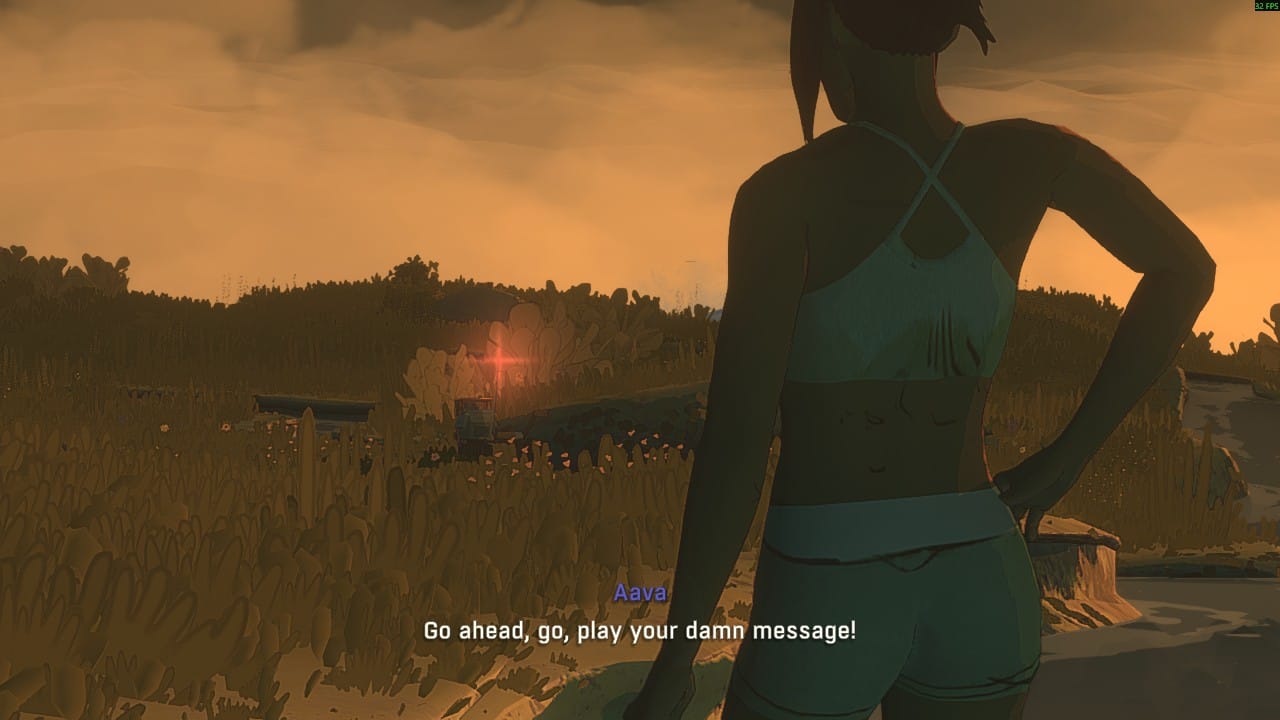
I am not like Aava. This, combined with the puppeteering orientation of control, detaches me further from my avatar within Cairn’s world. Videogames have a sliding scale of player and character agency. Bethesda’s Elder Scrolls and Fallout avatars lack any agency of their own, being complete voids that the player fills in with their own intent. The Witcher series, Cyberpunk 2077, and Red Dead Redemption 2 offer more defined characters who speak for themselves and allow the player to occasionally make their decisions, even if it sometimes contradicts previous ones or the character’s morals. On the other end, the Like a Dragon series has each avatar existing separate from almost any player input outside of walking within its spaces and engaging with its combat.
Cairn leans more towards the Yakuza lineage of separating character and player. It allows the player the option to control Aava’s social response only twice. The first is when/if to shut up fellow climber Marco when the two begin a climb together, and the second is whether to soldier onwards towards the summit or give up and return to the surface with Marco. This second option contains a false ending for Aava. Nothing about Aava’s attitude and dialogue leading up to this moment indicates she would ever give up on being the first to reach the top of Kami. Just earlier she offered to go down the mountain with Marco when he was having to confront potentially dying on the mountain. He calls her out on it and she is unable to hide the fact that the offer was a lie, she would never give up her ambition. Faced with what is being communicated as certain death, Aava would stubbornly trudge through it, not yield. Content determines intent in videogames, and descending is an early optional cutoff point, but not a final one. The game allows the player to resume their saved game after the descend ending in order to make the opposite decision and play on towards the summit, and true ending.[1] Most consequentially, this ending is fitting for Aava if not for the player. We desire to see Aava grow and embrace fellow humans, giving up the control she claims when on the mountain as a result of her isolation. Aava does not.
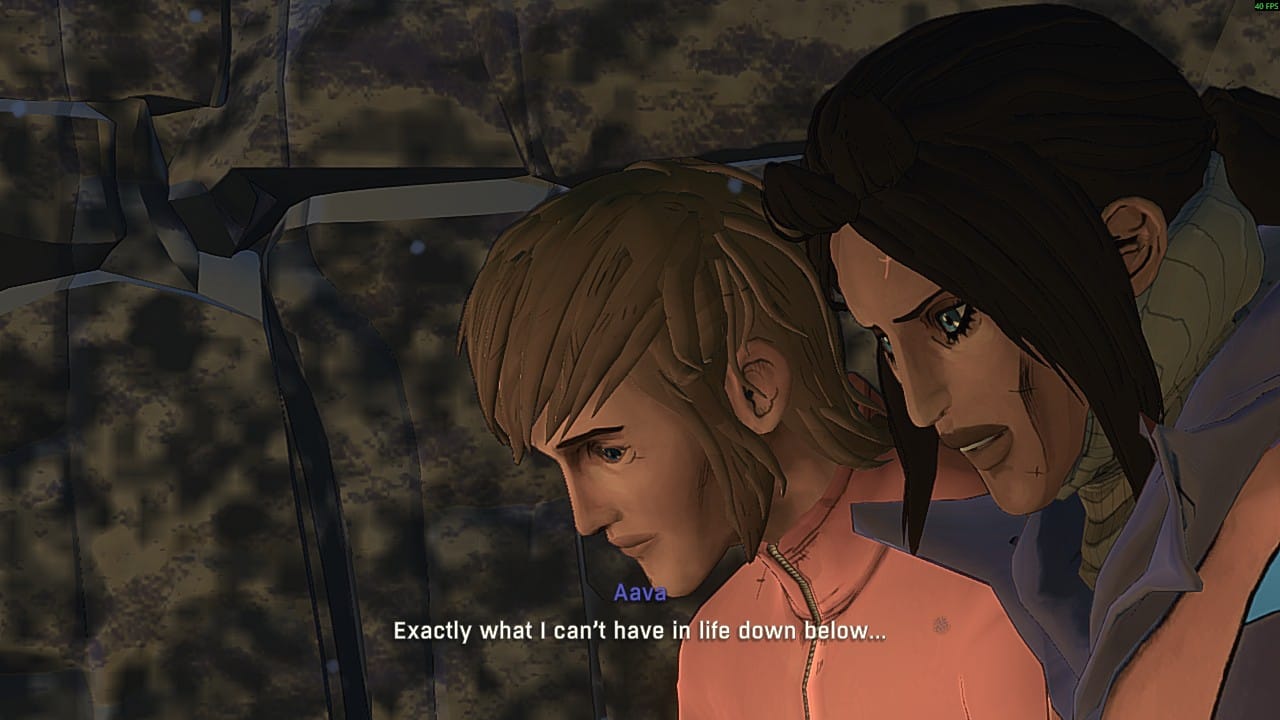
Her belief in having control is ironic considering the amount the player exerts over her while climbing. For Aava to believe herself in control on the mountain but actually be controlled by the player means she is living a false life. She is not being deceived so much as living within the deceit of videogames, this character thinks they are making conscious decisions themselves but in fact are nothing more than our plaything. This is further pushed by playing on easy mode where we can throw her about without consequence. On easy you can rewind time after a fall, scrubbing through a timeline to determine which position is best to return to to try again. Free solo, meanwhile, lies on the opposite end and guarantees a complete reset should Aava die. Naturally this leads to a much more minute intense concentration in how you are guiding and taking care of Aava for fear of losing all progress. The player is able to modify the rules being followed that lead to these two extremes, or pick the preordained “normal” difficulty that lies between them. The choice of difficulty weakens or strengthens our attentiveness to her.
Despite all this separation, a relationship builds between the two: player and avatar. A concerned and paternalistic attitude towards Aava is grown during the course of the game by acting as her caretaker. Aava has gauges for hunger, thirst, and warmth, and she must be fed, hydrated, bandaged up, and directed to sleep, all by the player over the 15 hours or so it takes to complete. It may be Aava performing the actions listed but it is the player initiating them. Bandaging Aava’s fingers requires the player to select each individual digit and rotate their joystick as they are wrapped. A tender moment that while viewed through first person, one which naturally assumes an embodying aspect, is instead read much more as a nurturing action that I am doing for her. All of this is repeated at each rest stop after a climbing session, allowing both Aava and the player to release their stress and relax together.
I originally thought of this tension between player and character, over who has the ability to exert more agency over the proceedings of the game, as a tug of war. Cairn shows this relationship more as a collaboration. Aava’s commentary on my decisions encourage or warn me of impending danger. Her screams of frustration at a fall matches my own grunts. Her exclamation of wonder at the things she is finding and reading are similarly reflected in me. I care for her like my own daughter, keeping her supplied and directing her when to eat and drink and rest. I watch her interactions and wish for a more fulfilling life than the one she is currently pursuing on this mountain, and the deadly end I know awaits her at its conclusion. I also know that it is her decision to make. I can only help her along.[2]
- ↩︎ This reminds me of the old false choice presented by games that ask, “Do you want to play the game or not play the game?” such as some late game missions in Red Dead Redemption 2 that ask you to accept or refuse it. In what instance has there ever been a reason to refuse?
- ↩︎ Sam Bodrojan recently talked with AP Thompson about Titanium Court, including a bit about puppets which was how Thompson viewed his game: What do you like about puppets? Puppets are abstractions or caricatures of people, and that gives you a lot. The abstraction level of the writing should match abstraction level of the art, and suddenly it feels appropriate, it feels whole. I think that working in abstractions lets you do interesting things. I liked this observation as Cairn is an abstraction: its time moves faster than ours, its Kami is a smaller simulacrum of our Everest, and as I’ll be arguing in the next article, Aava’s story is less traditional narrative and more parable, full of caricatures of pieces of herself who exist to warn her off of her fate.