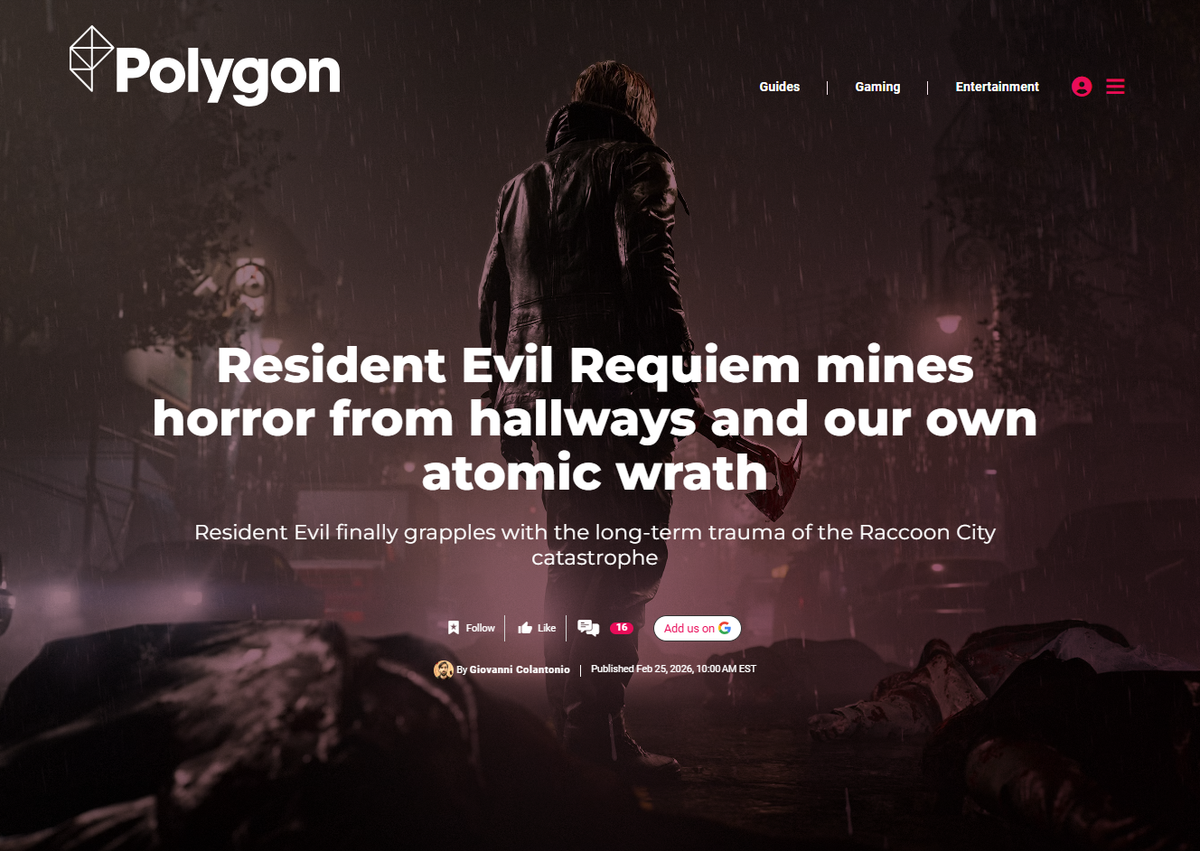
Reading Games Writing: Resident Evil Requiem review by Giovanni Colantonio

less posting and more conversation
This article is part of my series on responding to games writing and is a good faith attempt at starting a dialogue, not a personal attack or to feed the chuds on the usual channels of toxicity and trolling. Thank you for your time.
This review made waves online due to its opening paragraph in which the bombing of Hiroshima and Nagasaki by the United States using the newly invented atomic bomb is the lead in to talking about Resident Evil 9. Specifically how Leon Kennedy "is a survivor too," "has lived through hell," and, "never reckoned with the anguish he experienced there. He never stopped to remember the thousands that didn’t make it out in time. That is, until Resident Evil Requiem." The text of the review never backs up its claims and comparisons to justify bringing up one of the greatest atrocities of the past century.
To state the atomic bombings are, "so barbaric feels like it should have happened centuries ago," ignores the atrocities currently happening. Acting as if we have long evolved beyond the ability to commit such acts of terror and death against other human beings. We have the genocide in Gaza, in Sudan, Ukraine, Ethiopia, Myanmar, Yemen, Darfur, and many more extending into the hundreds of thousands of lives extinguished.
To make the claim that, "Leon S. Kennedy is a survivor too," in direct comparison to those who survived an atomic bomb means you have A LOT of justification to do. This never happens throughout the text of this review. Kennedy witnessed a zombie outbreak and the detonation from outside the city. This is presented as having "narrowly escaped town one day before it was wiped off the map by the United States government," and does not make him comparable to a 12 year old boy on his way to school who has his city obliterated and flees to a neighboring town where he dies before ever seeing his family again [x]. No image is provided in Colantonio’s piece, but I very much doubt the, "black mark under his [Leon’s] gloved gun hand that isn’t so dissimilar from the radiation burns etched into Hibakusha skin" comparison has any merit when you take time to look at the photos of the radiation burns on those who survived the blast.
Giovanni also claims this is the first installment that, "meaningfully connects its zombie fiction to real-world atrocities," ignoring Resident Evil 5. Its plot was of a pharmaceutical company creating and testing a new virus intended to genocide the world and birth a superior human race using Africans as its test subjects. This is connected to real-world history by a lengthy history of colonial projects, such as Pfizer conducting clinical trials to test a meningitis treatment in 1996. They failed to adequately inform the parents of the risks and intentions for their child test subjects, four of which who died, and settled out-of-court, paying $75 million to the Kano State government and $175,000 to the parents.
Throughout this review we are told that in this game Leon reckons with the anguish and remembers the thousands who didn't make it out in time. We are told that this game is "digital closure for one of gaming’s most likable heroes or for an era of PlayStation nostalgia." We are told that newcomer, "Grace’s trip through hell becomes a personal story about facing that tragedy and rising to the role of protector when needed." How returning to Racoon City allows, "its characters to finally unpack decades of grief, regret, and survivor’s guilt." How any of this is actually accomplished is never answered. What does Leon do or say that tells you he is reckoning with that anguish? How does Grace face her tragedy, and who is she protecting? There is even some doubt voiced towards these assertions as Kennedy is described as someone, "who seems as if he’s slowly coming to terms with the fact that he barely survived a massacre — and that so many others did not" Is he actually?
The dramatic introduction of Colantonio’s piece is severely cut down by the main body of the text failing to cite any examples to hold up its many declarations. The angle of this writing is likely crippled by an embargo preventing anything of substance being offered. As detailed by lex luddy on Bluesky, "This is going to be a really frustrating game to talk around for the next few days because basically every aspect of the game that didn't work for me falls under the *embargoed* details, so you are going to see a lot of points vaguely made with no visuals to support them across reviews." If Giovanni is going to be so weakened by being unable (charitably) or unwilling (uncharitably) to provide any direct examples to back up his statements when taking this heavy angle, then he would have been better off just doing a traditional graphics/sound/story review.
Further cutting through any seriousness is the typical ludonarrative dissonance, an overused term but nonetheless applicable given videogames' tendency to have its gameplay clash with its narrative intentions. Is Leon unpacking his emotional baggage when he "hacks zombie heads off with a hatchet, blows through bosses with a small artillery of guns loaded into an inventory that dwarfs Grace’s tiny backpack, and he can somehow parry chainsaws"? While running through the ruins is Leon meditating on his trauma while, "gathering points for each kill that he can spend to buy new guns and mods"? Is Grace overcoming survivor's guilt by soaking up blood to, "craft bullets, healing items, and stealth-killing injections"? I would love to offer additional context for these actions, especially the blood soaking currency, but none are offered in-text.
Too much of this review's text is "this is like this" with nothing of substance added to what that comparison means. Leon is a survivor like the Hibakusha. Racoon City is like Hiroshima and Nagasaki. The nuclear explosion was rendered like it is in real life. This is a text that can only say, "Resident Evil 9 takes place in a nuclear bombed American city, makes you think." That is why it does not earn the comparison of Leon Kennedy to the victims of Hiroshima and Nagasaki, to "the lives claimed by real-world tragedy.” I strongly reject the usage of tragedy here as it leans towards an absolution of responsibility. The atomic bombings were an action that could have been avoided, no matter how heavy the hand of American propaganda weighs around your neck telling you the opposite.
[special thank you to Don Everhart of Gamers with Glasses for the edits]