Replaying Call of Duty 4: Modern Warfare
A text worthy of exploration
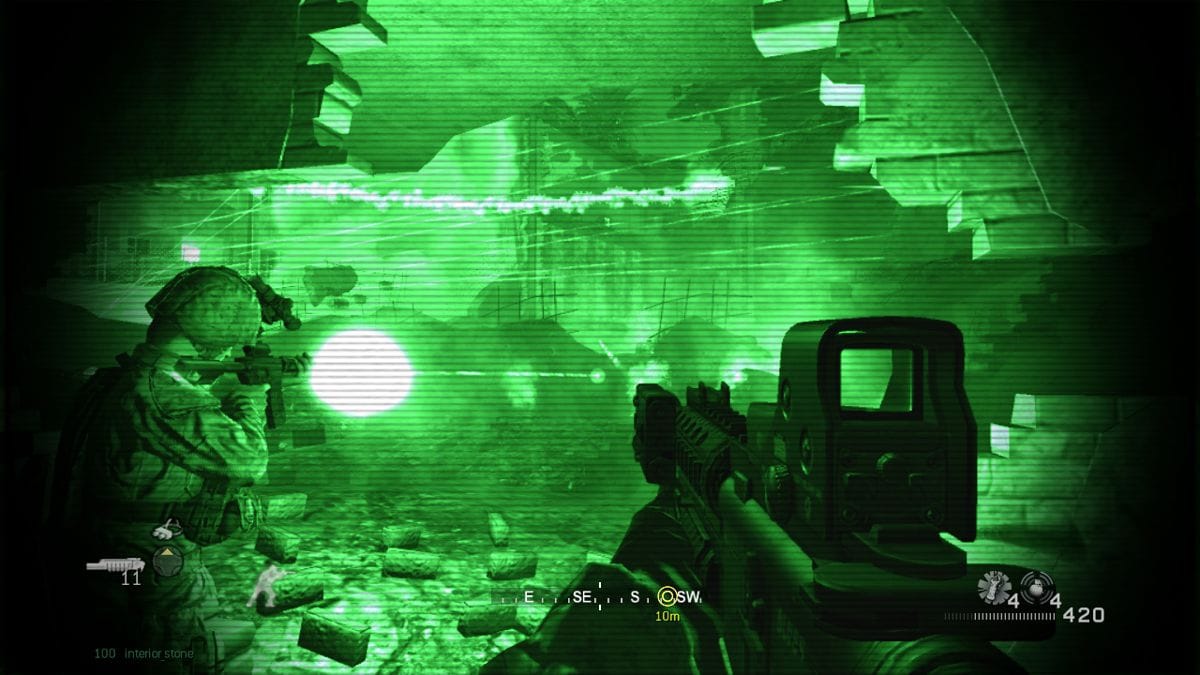
Preface: This was first published on July 24, 2019 as a Google Document that is still available to view, and alongside a video version on YouTube that you can watch here. As I would like to have a more centralized source of what I have done I am republishing this here. This was published prior to the latest reboot of the “Modern Warfare” subseries. My cynicism regarding that reboot present in this text was largely justified and partially covered in my follow up on Modern Warfare 2 that I will similalrly republish at a later time.
In late 2007, Call of Duty 4: Modern Warfare set itself as the standard for pretty much every major shooter to release after it, especially for new entries in its own franchise. Now, a reboot of the Modern Warfare sub-series is releasing later this year and selling itself as an even more modern Call of Duty, differentiating itself from the future warfare that has become routine in the series. So far the marketing campaign has promoted the presence of civilians, lack of a uniformed enemy, the renewed importance of night vision, and crossing of moral boundaries as a way to differentiate it from the previous iteration. With that impending release in mind I went back and played through Call of Duty 4: Modern Warfare to see how they interpreted conflicts of the time for a game, what they say about our viewpoints at the time, how they read now, and what it can inform us about the coming reboot. Despite what the developers may have said about avoiding commenting on the conflict they adapted, there are many things that Call of Duty 4 says indirectly through certain mechanics, plot points, and character portrayals. I wanted to go deep into this game largely because I believe that, taking from Justin Charity’s headline at The Ringer about Okay, Hero (which you too can buy now for only $5.99), Call of Duty 4: Modern Warfare is worthy of exploration.
Call of Duty 4: Modern Warfare was announced in April of 2007 with the general premise that, “a quartet of evil men threatens global peace. The Four Horsemen, as they are called, must be stopped. To do so, you’ll do some globetrotting through Russia and the Eastern Block and also through the Middle East. Don’t expect any excursions to Iraq -- while COD4 is realistic to an extent, it creates fictional conflicts and avoids any overt political commentary” (1). The “four horsemen” are taken from the Book of Revelation, where they are the embodiment of conquest, war, famine, and death depending on the interpretation. For the antagonists to be named after such a quartet alludes to their representation as a despicable force players will unthinkingly mow down in virtual landscapes.
This simplified approach to the complexity of actual war is something that recurs throughout all big budget games. Due to their large intended audience, the more vague and generalized the themes, the less chance they have of alienating a portion of the audience. Usage of the term “political” has only gotten worse since 2007. It also speaks to a longstanding conflict between interpretations of what that means when it comes to games. Julie Muncy spoke of this on her Twitter earlier this year in response to an interview with famed games writer Chris Avellone about apolitical games. Her response was, “Avellone thinks clearly that to be political means to be didactic, to contain concrete, specific messages about the state of the real world. He argues that the work he does should be about asking questions that emerge from the perspectives contained in his fiction. But, another (very reasonable group, to which I largely subscribe) would say that “asking questions that emerge from perspectives in the fiction” is *exactly* what being political is--interrogating our relationships to each other and the world. It’s a clash, I suspect, between a very American definition of politics that includes elected office and little else, and a more lefty academia-infused definition of politics that encompasses all of shared life. One definition leads to a different answer than the other.” Infinity Ward, by refusing to include any overt messages about the war in Afghanistan and Iraq, think they are avoiding politics by doing so. However, as we will see, their work still includes quite a few political messages, even if it’s unintentional.
That thread of establishing villainy is reinforced in an interview with Grant Collier in July of 2007: “We want it to be a black and white sort of struggle. So you’ve got to build up a bad guy early on in the game, in some of the first few missions, make him do some really horrible stuff, because we don’t want ‘he’s a really bad guy’ in the manual, we want to use the missions to drive home the point that this guy and his lackeys are all really really nasty guys” (2). That “really horrible stuff” is the second mission in which you play as democratically elected (read: morally righteous) President Yasir Al-Fulani who is killed in a coup performed by Al-Asad, modeled after middle eastern dictators. with the backing of Imran Zakhaev, a descendent of the Soviet Union. Prior to the broadcast execution, you are driven through the streets of a city and witness Asad’s men chasing and killing civilians everywhere, setting up how bad these people are and how necessary it is to stop them. Not that the United States needs this much justification to meddle in a foreign country. From overthrowing Queen Lili’uokalani in Hawaii in order to annex it, to backing anti-communist forces in the Russian civil war to restore the Tsars, and the many Cold War coups and assassinations, the United States has always been a country that intrudes in another’s affairs under the policy of interventionism.
Four months before Call of Duty 4 was announced, Saddam Hussein was executed by hanging. The war in Afghanistan and Iraq were not going well, and public opinion was beginning to turn sour and outweigh the previously held belief that a military invasion was the right decision. Unlike reality, Call of Duty would not have a complex web of disinformation fueling its foreign invasion. The setting is simplified: a president is murdered, civilians are dying, we are going to invade and restore the peace quick and clean, just like we aimed to do with the men who Asad acts as a stand in for.
Unsatisfied with just presenting a Middle Eastern-based foe, a spectre of the Soviet Union hangs over Call of Duty 4 as well in the form of Zakhaev, an ultra-nationalist hoping to revolutionize Russia back to the days of Communism (3). While there was a group of ultra-nationalists in Russia at the time of development, President Vladimir Putin (in his first term) was very popular among the people. This makes a civil war within Russia a stretch, but somewhat believable in 2006 during development. Putin was criticized at the time of Call of Duty 4’s release, and still is, for moving away from democracy and towards the autocracy of the USSR, making Zakhaev read more like a potential co-conspirator than rebel leader. Putin even has a death quote in-game: “Whoever does not miss the Soviet Union has no heart. Whoever wants it back has no brain.” This seemingly is directed at Zakhaev, who speaks openly about regressing back to the time of the USSR during his speech in Ultimatum. Again, Putin’s anti-Western attitude puts him more in line with Zakhaev than the Loyalist v Ultranationalist conflict would lead you to believe. Gaz even mockingly asks at the beginning of Blackout whether Kamarov belongs to the “good Russians,” or the “bad Russians,” as if there is little difference between the government loyalists (underneath President Putin at the time of development) and the ultranationalist rebels (whose leader largely matches Putin’s rhetoric).
In reading some interviews it is clear that Infinity Ward were somewhat obsessed with the belief that the most important work they were doing was to enable immersion, something desired and chased after by almost all the big games of the late 2000s. “We really feel that it’s really hard to get a player immersed in the game, to make him believe - I’m actually there, I’m in that conflict, I’m no longer holding a piece of plastic in front of a screen that’s flashing lights, y’know. I’m sweating, I’m starting to swear, I’m actually dodging bullets in my seat, that’s a wonderful thing.” The key to that immersion? 60 frames per second at all times. Now obviously everything else about the game from audio to animations to plot progression are also supposed to support that kind of desire of immersion, but in the context of that interview it was about frames per second, a technical nitpick that plagues any kind of talk on video games to this day.
This kind of thought process, unique to video games, is the same type that plagues pretty much every Call of Duty. Each entry is both 1. A send up and appreciation of the soldiers and their experiences, sacrifice, and bravery. And 2. A fun video game that is enjoyable to play. This is nothing new to games in general, but becomes much more plain in regards to Call of Duty, a series that regularly brings in veterans to help verify their authenticity. Even this sort of validation only goes so far, as retired Army Lieutenant Colonel Hank Keirsey, of the 82nd Airborne Division describes when talking about Call of Duty 4, “I look at the Javelin movement, and I can see that the real Javelin doesn’t go that high. But they say ‘Yeah, we know, but we like it like this, it looks cool.’” Even Keirsey, though, buys into the contradiction of the game in the end, “But when a kid plays this game, he sees what soldiers are going through right now. He gains an appreciation of what that one out of a thousand Americans that are now deployed in combat, in a rotten war, are having to experience. They don’t get to choose the war, they don’t get to choose the battlefield, they go where they’re told” (4).
Michael Thomsen explores this dichotomy that Infinity Ward, and others, don’t see or talk about. “For how real COD4’s technical rendering of modern day war zones are, the necessity of making the game fun to play have totally neutered its thematic construction.” (5) Some of Thomsen’s critiques, specifically that of, “no neutral by-standers, no children, no widows, no widowers, no confused villagers, no clever terrorists pretending to be an innocent villager.” is being addressed in the reboot launching this year. In this Modern Warfare, Taylor Kurosaki explains, war has changed. “What does Modern Warfare mean in 2019? It means the battlefield is blurrier than ever. It means enemies don’t wear uniforms, it means that collateral damage is a real part of the equation. People having to make split-second life-or-death decisions” (6). Although, as some others have pointed out, this aspect of war is nothing new. Not to modern war, and not to wars from decades ago.
This conflict is reflected in Austin Walker’s headline for Modern Warfare’s preview: ‘Call of Duty: Modern Warfare’ Can’t Decide Whether War Is Bad or Badass. Sadly, this speculation was already answered in Call of Duty 4: Modern Warfare as Thomsen’s writing points out, and has been again and again with each and every Call of Duty game. The kind of writing by Sam Machkovech at ArsTechnica really contains the sort of bite necessary to actually engage with these press events as more than PR blasts. In the game, Price, voicing the intent of the developers, warns, “There may be non-combatants on target. Check your shots.” Machkovech writes in a highlighted quote as a response, “—yeah, right.”
Friendly fire and civilians are nothing new to Call of Duty, despite what Infinity Ward may want you to believe with their reboot. Throughout Call of Duty 4 you are capable of killing friendlies, so long as they aren’t key characters, without nary a consequence. Blow up Price or Gaz though and it’s a checkpoint restart for you. In Modern Warfare 2, during the Rio de Janeiro missions, civilians appear intermixed with similarly dressed militia, and shooting innocents also ends in a checkpoint restart. For this year’s Modern Warfare to include civilians in the line of fire isn’t new, and there is little detail to expect their treatment to be any different this time around.
That last part of Keirsey’s quote, about the soldiers not getting to choose the war, really exemplifies something mentioned earlier: while Call of Duty 4 draws from actual events, it won’t say anything about those influence besides they exist. This attitude continues in Medal of Honor (2010), EA’s direct response to Call of Duty 4, as well as many games in our current time, especially the Ubisoft kind. This form of neutrality reinforces the status quo, as it reads as acceptance of the motivations behind modern wars as a fact that cannot be disputed or changed, even if it deserves to be.
All of this is a pretext to the actual text of Call of Duty 4: Modern Warfare. Starting a new game sets up the world: a Russian civil war is ongoing between governmental loyalist and ultranationalist rebels, Asad is gaining power in the Middle East, and there’s a FNG (Fucking New Guy) fresh from selection ready to be added to the SAS, Britain’s Special Air Service. You are the FNG, and the first action you are directed to do is arm yourself with a gun. With this gun you have power. It is your main and only way of interacting with the world. Sometimes that gun is a claymore or a remote detonator, but at all times it is holding a thing made to kill. Without that gun you are nothing. Throughout the game you will always have a gun in hand save for the select times you are subjected to greater powers and the gun is put away as it is useless or unavailable at the time. These set pieces, such as the boat sinking in Crew Expendable, being a captured president in The Coup, being subjected to a nuclear explosion, and nearly being executed in the finale, are times when the player is disempowered because of the lack of a weapon. They are robbed of agency via the removal of their only way to interact with the world. Call of Duty 4 teaches you that a soldier with a gun in hand can accomplish great feats, and without it are simply subject to the whims of the world surrounding them.
The inability to holster your weapon wasn’t even something I thought about until it was coded into me by repeated play of Apex Legends, curiously enough coming from largely the same lead developers of Call of Duty 4. In Apex, holstering your weapon gives you a slight speed boost. Since it is a competitive video game it is natural that optional mechanics have to have an effect. Present in many video games is a sense of pragmatism, that an action that can be taken has to be justified by some type of risk and reward. This can be compelling in the right situations, but can also reveal the beliefs of the developers. In this case, the lack of putting your gun away in Call of Duty 4 shows how much the gun is valued. Why would you want to put it away? So much care was given to modeling it after its real-life counterpart, so much work went into the varied reloading animations and unique sound of each weapon being fired, there is no reason not to have it present at all times. This belief still exists, as the 2019 Modern Warfare preview event included the quote, “The weapons are the stars, and the player must [emphasis added] feel like a badass when they wield them.”
Due to the importance of having a gun, a lot of love and care went into the weapons, making them appealing and memorable. A lot of the aesthetic of Call of Duty games comes from the onomatopoeia: guns firing (now with silencers sometimes altering the sound), reloading, the whooshing that accompanies death, grenades hopping, NPC barking. These are the sound clips that activate a sort of sleeper cell response in us and are instantly recognizable as this franchise due to the repetition of their usage for the past 16 years.
During Crew Expendable, Gaz quotes from Corporal Dwayne Hicks in the film Aliens when pulling out his shotgun, “I like to keep this handy, for close encounters.” In this reference, Call of Duty 4 is emulating the sort of hyper masculinity of the space marines of Aliens in the SAS. These guys are BADASS. However, Call of Duty 4 lacks the part of Aliens where that hypermasculinity is massacred in favor of a mother figure in Sigourney Weaver. Not that there are many women in Call of Duty 4 other than the disembodied reporter and Cobra pilot Pelayo who requires rescuing after her helicopter was shot down. Infinity Ward are happy to list out their film influences, though this instance shows how that reference is only surface level, and lacks the follow through present in the film. The space marines of Aliens are portrayed as badass, but all that weaponry can’t save them from the xenomorphs in the end. Meanwhile the SAS are portrayed as badass, and all that weaponry can and does lead them to the ultimate conclusion, even if sacrifices are made along the way.
Crew Expendable also introduces the real world fear present in the Western world of an unauthorized country gaining access to nuclear weapons. The belief of Iraq holding WMD’s was what fueled the United States invasion of that country, with no WMDs found over a decade later. This same fear, now directed at Iran, threatens to plunge the US into another war that serves no purpose. This fear is what justifies the policy of interventionism by both the United States and Britain in Call of Duty 4, which reflects the interventionism of reality. This fear is why in the fiction of Call of Duty 4, Britain authorized an assassination on foreign soil in 1996, and why fifteen years later the US invaded the “small but oil rich nation” under Al-Asad. In real life this policy led to the Korean war, the Iranian coup in 1953, the Guatemalan coup in 1954, the Gulf War, the invasion of Grenada, Panama, and Iraq, and now continues with the Syrian Civil War (seemingly a point of inspiration for this year’s Modern Warfare). In that latter case we are more than happy to bomb the country repeatedly while refusing to deal with the massive migration of civilians seeking asylum as a result. As soldiers, the characters of Call of Duty 4: Modern Warfare don’t really have much to say about the greater consequences of their missions and invasions other than that they are happening or have happened, reflecting the reluctance of the developers to comment on the conflicts they are adapting.
This lack of voice isn’t surprising. As mentioned before, this game “avoids any overt political commentary.” Despite this, it is well established that engaging in neutrality favors the status quo. In this case it is the belief that WMD’s are safer in the hands of the United States and its allies than in other countries, a belief that fueled the Cold War and continues now with places like Iraq and Iran. This aversion to change in the status quo is largely present throughout Western media, namely the current reigning blockbuster franchise from Disney: the MCU. Not only does it favor the status quo, but a persistent theme is that of authoritative power only being held by the good guys, even if that system of power is inherently flawed. Asad, with his speech of revolution backdropped by the massacre of civilians, would fit neatly among the villains of Killmonger and Quentin Beck, who both make no qualms about killing children as part of their plans. Asad is clearly a bad man, made only worse later on by the revelation of his collusion with a Cold War descendent. His speech is about taking the country back from serving Western interests (re: oil) and saying, “let us show that we do not fear them,” brings to mind the current provocations between Iran and the US. Call of Duty 4 may make no effort to question or critique the processes behind which wars happen, but that is more than enough to show that it accepts them as just.
The introduction of the United States Marine Corp in the game is under the objective to quickly capture Al-Asad and end the war. This optimism is similar to that which fueled the invasion of Afghanistan, the capture of Osama bin Laden. Much like that goal, the capture of Al-Asad becomes more complex, though reduced significantly when compared to the decade long search for Osama bin Laden. Ultimately he is captured and killed, but much like in real life, that is not the end to the conflict. Modern Warfare 2 picks up five years after the first, and shows that those who were killed, namely Zakhaev, are now revered and used as justification for hatred of the United States. Killing Asad and Zakhaev didn’t change the conditions under which they were created and rose to prominence. Reality, and Call of Duty to an extent, don’t work under the gamified logic that killing the boss automatically renders their underlings nonexistent.
Throughout the United States Marine Corp missions, the player gets a sense of what the game is directly saying: about the noble heroism and bravery of soldiers, about the sacrifice required for victory and the fatality of combat. In the mission War Pig, you’ll fight through a virtual hell that extends for four blocks, every foot of progress under fire and the threat of setback via death.
This constant presence of death and reset has been noted as an example of how impossible combat situations like this are to actual humans, but they are situations that real human beings are placed in due to war. Playing the campaign on Veteran is supposed to be the most closely rendered thing to reality, where a few bullets can drop you dead. Even then the checkpoint system keeps you going. Its this repeated respawning that enables the player to succeed, the sort of repetitious adaption and changing of action that caused Edge of Tomorrow (based on the manga All You Need is Kill) to be hailed as, “Hollywood’s best videogame adaptation.” Respawning is also a feature that helps cause the numbness to violence within games themselves that has been chronicled for years and years now. Frankly I have nothing to meaningfully contribute to that conversation other than to direct you to writers who have already talked about it at length.
“No sacrifice, no victory” rings true not only for fallen NPCs during missions, but for the player themselves in certain missions. A taste of this was given with the execution of Al-Fulani during The Coup, which unfolded in the first person perspective for the player. It reaches full fruition in Aftermath. The end of Shock and Awe sees the player commit another act of bravery and heroism by saving the downed Cobra pilot Pelayo. After a few USMC missions this seems rather routine, putting oneself in danger to save others. Then, the backdropped threat of a nuclear weapon becomes reality when it is set off, and due to your last minute save, the helicopter you, and others, are in is brought down and everyone dies. The heroism on display in this mission is the kind of contradiction found throughout war fiction and reality: the many putting their lives on the line to save the few. In Hollywood, Saving Private Ryan chronicles the fictional efforts of a team of soldiers dying one by one to save the one titular Private Ryan. Call of Duty even revisits this situation in 2017’s WWII, where Technical Sergeant William Pierson’s backstory is given a twist reveal. What was once thought to be a mindless charge on the enemy that resulted in disaster was actually a heroic attempt to save a pinned squad that ended in failure. The player character dies, but died for a noble cause, and that is enough to separate their name from the long list of Marines during the briefing screen of Aftermath.
It is impossible to separate the imagery and usage of nuclear weapons in a fictional work such as Call of Duty 4 from their actual usage on Japan. This is especially complicated by the faint audio of playground noises present as the player approaches one in Aftermath. It appears to be a damning gesture towards Al-Asad, who would dare use a nuclear weapon on his own people. It makes no gesture towards the blood on the United State’s hands for our usage of the bombs to kill hundreds of thousands of civilians. Instead the United States are the victims, with audio evoking deceased children added on to further vilify Asad. This sort of portrayal borders on cartoonish as the next mission opens with the cries of villagers being massacred by ultranationalists, Asad’s closest allies. This is the game reminding you yet again that these are bad men. The mission after the nuclear explosion occurs ends with Price beating a bound Asad, ultimately executing him with a shot to the head after he learns that Zakhaev supplied the nuclear material. This is where the game tilts from conflict between superpowers to conflict between supermen. An angle that is only increased in its sequels with General Shepherd and Makarov. Later on, your ally Staff Sergeant Griggs is taken prisoner and an ultranationalist tells him, “the Geneva Convention is a nice idea in theory, you know?” and follows up by asking his comrade where the hacksaw is. Asad’s beating and execution is justified while Griggs’ situation is to show the inhumanity of the bad guys. Ultimately, the things the game protrays as morally bad, such as killing civilians, nuking a city, threats of torture, are indeed bad things. It is what these depictions represent in the greater context of the world that makes them something to be wary of. An assumption the game reinforces is that nuclear weapons are safer in the hands of the United States and its allies, though it doesn’t consider who that safety favors.
Many of the USMC missions also appeal to the lifetime of Hollywood films, games, and boys’ toy marketing that makes you watch a helicopter destroy a building with rocket fire, a tank crush a car underneath its treads, and a Javelin missile fly up and then down onto enemy armor and think, “Fuck, that’s cool.” It is the American tradition that sees you evolve from water guns and Nerf guns to paintball and airsoft, and then to the real thing. From there you can either hoard the weapons in a paranoid obsession or commit a mass shooting, suicide, or mariticide . Those are what guns are used for, but it doesn’t stop myself and others from having this instinctual, cultural response to look at the gun models in Call of Duty and think, “that’s cool.”
This coolness is most on display during certain briefing screens, where a breakdown of the armory on display in the mission (War Pig) or in use by the player (Death From Above) is presented in a way that just screams, “Check out this big gun!!” Juxtaposed against this are the death quotes that run through the gamut of the futility and cost of war, in both financial and human numbers. These quotes also come from some really terrible people. Robert McNamara, who helped cause the Cuban missile crisis and increased our involvement in the Vietnam war, and whose later regret has largely absolved him in the popular culture of culpability, has six quotes, the most of any named individual (“Unknown” is attributed eight quotes). These quotes seemingly come from his time of regret, as they mostly have to deal with mulling over killing, mistakes, persuading nations of our cause, luck in the role of survival, and the looming threat of nuclear weapons. These of those themes are present in a majority of the death quotes but are rarely seen in a playthrough of the game itself. There is no thinking behind the killing, there is no persuasion to be had. Luck is what helps the player succeed, backed by respawning, and the threat of nuclear weapons is present as a Cold War descendent. These quotes would have the player think about the actual cost of war, but only before they are thrown back into the midst of a mission where they kill hundreds of nameless opponents as an instant reaction to their presence. The auto-aim function helps this, since as soon as you see an enemy peak out of cover you can snap right to them to deliver death. Left trigger, right trigger for five hours straight.
Throughout missions you might recognize the skyboxes and far backgrounds as nothing more than matte paintings like those used in film production before the rise of CGI. If you’ve watched YouTube glitch videos you’ve probably seen the behind the scenes areas of campaign and multiplayer maps where you can go out of bounds and view places not intended to be seen. Following that pragmatic thinking I mentioned before, developers don’t model things that are out of sight, and it is easier to have the far distance surrounding you be a flat texture than 3D models. The best view of this is in free cam spectator mode in multiplayer, where you can see that the map is a square landscape where the most detail goes into the play areas and the farther you go from that center the less detail there is. This isn’t a unique feature to this game at all, but sometimes noticing it gives you a sense that this is all a performance, akin to theater. Replaying games such as this, you can begin to see behind the curtain, at all the various triggers the game is requiring. As director, Infinity Ward has set up cues: enemy spawning and despawning, set piece triggers, NPC barks, all that the player has to move about in to bring about a proper performance. This is heightened when performing video capture, as I did on my replay, where you want to give a good performance for not just the game and yourself but for those who might watch your video. Every first playthrough of a game is something of wonder, as you poke and prod at the game to see what it’s capable of. All subsequent replays only reveal the systems that allowed that first wonder to exist. Eventually you reach a point of rehearsed replay, where you recount to other viewers how this mechanic is unique to a few sections or to watch the set piece occur on cue.
One of the most talked about missions in the game is the one in which players control the weaponry of an AC-130 (Death from Above), and rightly so. Whereas the developers sought to immerse the players in the actual boots of a soldier with their grounded first person levels, Death from Above is about the detached coolness present when combat is viewed through the black and white screen of a machine. The AC-130 disconnects the player from the familiar ground level combat and renders everything in a white/black heat screen where your immediate effect of action is now delayed. You can easily fire off a round and move on, not even bothering to view the full effect of what that round does to the ground below. When occupying the perspective of an SAS soldier, gun in hand, you are powerful. However, the mission immediately before Death from Above, Hunted, has you running for escape, trying, and failing, to avoid open combat. While you are still powerful, you still kill many more than any real soldier would, the mission is supposed to challenge you. The finale of the mission is a taste of the power of the AC-130, as it effortlessly decimates a column of enemy armor and infantry. It then gives you that power, the ultimate fantasy of being able to kill without fear of recourse as none of the enemies below have the ability to fight back against you. This disconnect due to remote warfare has only increased with the introduction of drones to war, an element that was introduced in Modern Warfare’s sequels.
None of these thoughts and criticisms make the game any less playable. As I mentioned before, the game greatly succeeds at tapping into that “fuck yeah!” affection taught by a lifetime of media. It also greatly helps that its mechanical foundation, which has been talked about to death in mainstream media circles, is sound. The shooting is precise, responsive, and of high enough quality that you can unthinkingly do it repeatedly for five hours. Missions are varied, the story is simple with its black and white portrayal of who is good and who is bad, and it chugs along at such a pace that you’ll never be bored. In essence, the game is satisfying to play. Thankfully, it’s not devoid of any other analysis separate from its “fun factor.” It is this fact, that the text has so much you can extrapolate from and explore is why I’m still immensely curious about what this reboot will say. I just don’t trust in anything other than the text itself, previews be damned.
Many of the themes and elements featured, intentionally or not, in Call of Duty 4: Modern Warfare were there before, and continued to be to our current time. There is no basis of faith that this reboot, Call of Duty: Modern Warfare, is going to be any different. While the developer may name influences such as the documentary Last Men in Aleppo, the game itself is not going to introduce any sort of real world complexity to its conflict, especially when it comes to the Syrian civil war. Just like every Call of Duty this is a game first, and has to be playable by a huge audience to justify its continued existence. War in Call of Duty will remain a performance art, with whatever developer at the time its director and the player as the main actor. The performance will wow the player with its cool set pieces, and ask them to momentarily contemplate the cost of war before handing them powerful weapons that will be ever present. Bullets in Call of Duty will remain the only way through which you interact with the world.
Works Cited
heySwifty | Random Games & More. “Call of Duty: Modern Warfare REMASTERED | “Epilogue” Mission.” YouTube, 12 November 2016.
Charity, Justin. “The ‘Metal Gear’ Universe Is Worthy of Exploration.” The Ringer. 18 July 2019. https://www.theringer.com/2019/7/18/20698585/metal-gear-video-game-hideo-kojima
Bullet Points. “Okay, Hero.” Itch.io, 17 July 2019. https://bulletpoints.itch.io/okayhero
@juliemuncy23 (Julie Alexis). “It’s a clash, I suspect, between a very American definition of politics that includes elected office and little else, and a more lefty academia-infused definition of politics that encompasses all of shared life. One definition leads to a different answer than the other.” Twitter. 31 May 2019, 1:06 p.m.,
https://twitter.com/juliemuncy23/status/1134551704475713536
McKeand, Kirk. “Can stories be apolitical? We asked some video game writers and narrative designers.” VG24/7. 31 May 2019. https://www.vg247.com/2019/05/31/can-stories-apolitical-asked-video-game-writers-narrative-designers/
Goldstein, Hilary. “Call of Duty 4: Modern Warfare Preview.” IGN, 13 June 2007. https://www.ign.com/articles/2007/06/13/call-of-duty-4-modern-warfare-preview
Shea, Cam. “Call of Duty 4: Modern Warfare AU Interview.” IGN, 13 June 2007. https://www.ign.com/articles/2007/06/14/call-of-duty-4-modern-warfare-au-interview
SycoSquirrelSSU. “Call of Duty 4: Modern Warfare - Campaign - The Coup.” YouTube, 24 September 2011.
Kinzer, Stephen. Overthrow: America’s Century of Regime Change from Hawaii to Iraq. London, Macmillan, 2007. Print.
Wright, Damien. Churchill’s Secret War with Lenin: British and Commonwealth Military Intervention in the Russian Civil War, 1918-20. Warwick, Helion Limited, 2017. Print.
Salisbury, Harrison Evans. Black Night, White Snow: Russia’s revolutions, 1905-1917. New York, Da Capo, 1981. Print.
Foreign Relations of the United States, 1961–1963, Volume X, Cuba, January 1961–September 1962 Document 291. Program Review by the Chief of Operations, Operation Mongoose (Lansdale). Washington, D.C., 18 January 1962. Print.
Kettle, Martin. “President ‘ordered murder’ of Congo leader.” The Guardian, 10 August 2000. https://www.theguardian.com/world/2000/aug/10/martinkettle
Rosentiel, Tom. “Public Attitudes Toward the War in Iraq: 2003-2008.” Pew Research Center. 19 March 2008. https://www.pewresearch.org/2008/03/19/public-attitudes-toward-the-war-in-iraq-20032008/
Ring, Bennett. “E3 2007: Call of Duty 4 Extended Eyes-on.” IGN. 12 July 2007. https://www.ign.com/articles/2007/07/12/e3-2007-call-of-duty-4-extended-eyes-on
Clark, Amy. “Racist Ultranationalism Growing In Russia.” CBS News. 4 November 2006. https://www.cbsnews.com/news/racist-ultranationalism-growing-in-russia/
Morin, Ricahrd and Samaranayake, Nilanthi. “The Putin Popularity Score.” Pew Research Center. 6 December 2006. https://www.pewresearch.org/global/2006/12/06/the-putin-popularity-score/
Feifer, Gregory. “Russia Under Putin: Echoes of the Soviet Era.” NPR. 6 March 2007. https://www.npr.org/templates/story/story.php?storyId=7678874
Tong, Sophia. “Spot On: The music of Braid.” GameSpot. 13 September 2008. https://www.gamespot.com/articles/spot-on-the-music-of-braid/1100-6197644/
Torres, Ricardo and Shoemaker, Brad. “Grand Theft Auto IV Update - A Day in Liberty City.” GameSpot. 25 July 2007. https://www.gamespot.com/articles/grand-theft-auto-iv-update-a-day-in-liberty-city/1100-6175585/
“How to Increase FPS in Fortnite.” More FPS. 2019. https://www.morefps.net/how-to-increase-fps-in-fortnite
Ring, Bennett. “Call of Duty 4 AU Interview.” IGN. 22 July 2007. https://www.ign.com/articles/2007/07/23/call-of-duty-4-au-interview
Thomsen, Michael. “Contrarian Corner: Call of Duty 4.” IGN. 28 December 2007. https://www.ign.com/articles/2007/12/28/contrarian-corner-call-of-duty-4
S3kShunN1N3thr33. “Metal Gear Solid 4 Opening Cutscene in HD.” YouTube. 20 June 2010.
Palumbo, Alessio. “Call of Duty: Modern Warfare Will Make You Question Your Morality as a Player, Says Dev.” Wccftech. 2 July 2019. https://wccftech.com/call-of-duty-modern-warfare-question-your-morality-player/
@Chef_Lu_Bu (Romance of the Three Kitchens). “@austin_walker this kinda stuck out to me: “What sort of social commentary? Well, war, they say, is “more complex than it was 10 years ago.” I was in Iraq in 2003. By my math, that’s slightly over 10 years. Slightly. Nobody was wearing uniforms in 2003 but us.” Twitter. 30 May 2019, 10:22 a.m.,
https://twitter.com/Chef_Lu_Bu/status/1134148176573861888
Walker, Austin. “’Call of Duty: Modern Warfare’ Can’t Decide Whether War Is Bad or Badass.” Vice. 30 May 2019. https://www.vice.com/en_us/article/7xgemq/call-of-duty-modern-warfare-cant-decide-whether-war-is-bad-or-badass-preview
Dayus, Oscar. “Ghost Recon Breakpoint Not Making Political Statements, Ubisoft Insists Despite Obvious Themes.” GameSpot. 10 May 2019. https://www.gamespot.com/articles/ghost-recon-breakpoint-not-making-political-statem/1100-6466778/
@CallofDuty (Call of Duty). “Loadouts locked. Gear up for the #ModernWarfare Multiplayer Gameplay Premiere on August 1st.” Twitter. 22 July 2019, 10:00 a.m.,
https://twitter.com/CallofDuty/status/1153349005319032832
Branigan, Tania. “Korean war: ‘There’s still the evidence to show it was American imperialism’.” The Guardian. 25 June 2010. https://www.theguardian.com/world/2010/jun/25/korean-war-american-imperialism-veterans
Dehghan, Saeed Kamali and Norton-Taylor, Richard. “CIA admits role in 1953 Iranian coup.” The Guardian. 19 August 2013. https://www.theguardian.com/world/2013/aug/19/cia-admits-role-1953-iranian-coup
Kettle, Martin. “Clinton apology to Guatemala.” The Guardian. 12 March 1999. https://www.theguardian.com/world/1999/mar/12/jeremylennard.martinkettle
Greenblatt, Alan. “Twenty Years Later, First Iraq War Still Resonates.” NPR. 24 February 2011. https://www.npr.org/2011/02/24/133991181/twenty-years-later-first-iraq-war-still-resonates
Brown, Colin. “US troops invade Grenada – archive.” The Guardian. 26 October 2016. https://www.theguardian.com/world/2016/oct/26/us-troops-invade-grenada-archive
Vulliamy, Ed. “How a US president and JP Morgan made Panama: and turned it into a tax haven.” The Guardian. 10 April 2016. https://www.theguardian.com/world/2016/apr/10/panama-canal-president-jp-morgan-tax-haven
Borger, Julian. “There were no weapons of mass destruction in Iraq.” The Guardian. 7 October 2004. https://www.theguardian.com/world/2004/oct/07/usa.iraq1
Chulov, Martin; Abdul-Ahad, Ghaith; Graham-Harrison, Emma; Black, Ian; and Kingsley, Patrick. “Syria’s civil war: five years of Guardian reporting.” The Guardian. 14 March 2016. https://www.theguardian.com/world/2016/mar/14/syria-civil-war-five-years-guardian-reporting
Hornshaw, Phil. “Call Of Duty: Modern Warfare Dev: ‘We’re Not Talking Out Of Both Sides Of Our Mouths’.” GameSpot. 11 June 2019. https://www.gamespot.com/articles/call-of-duty-modern-warfare-dev-were-not-talking-o/1100-6467239/
Younes, Ali and Aaronson, Trevor. “US intensifies bombing in Syria after Trump announced withdrawal.” Aljazeera. 3 January 2019. https://www.aljazeera.com/news/2019/01/intensifies-bombing-syria-trump-announced-withdrawal-190103083014951.html
Borger, Julian. “Syria: US, UK and France launch strikes in response to chemical attack.” The Guardian. 14 April 2018. https://www.theguardian.com/world/2018/apr/14/syria-air-strikes-us-uk-and-france-launch-attack-on-assad-regime
Zezima, Katie. “The U.S. has slashed its refugee intake. Syrians fleeing war are most affected.” The Washington Post. 7 May 2019. https://www.washingtonpost.com/immigration/the-us-has-slashed-its-refugee-intake-syrians-fleeing-war-are-most-affected/2019/05/07/f764e57c-678f-11e9-a1b6-b29b90efa879_story.html?noredirect=on&utm_term=.de2546efec0f
Wiesel, Elie. “Nobel Prize Speech.” The Elie Wiesel Foundation for Humanity. 10 December 1986. Oslo, Norway. http://eliewieselfoundation.org/elie-wiesel/nobelprizespeech/
Kahneman, Daniel, Jack L. Knetsch, and Richard H. Thaler. 1991. “Anomalies: The Endowment Effect, Loss Aversion, and Status Quo Bias.” Journal of Economic Perspectives, 5 (1): 193-206. DOI: 10.1257/jep.5.1.193
McCarthy, Nick. “Here’s the Hidden Message in Every Marvel Movie.” IndieWire. 14 April 2015. https://www.indiewire.com/2015/04/heres-the-hidden-message-in-every-marvel-movie-63117/
Santana, Steven. “Tony Stark the Center of the Universe.” Google Drive. 14 July 2019. https://drive.google.com/file/d/11EGuUCNekPSOhWIGyycF50dJiSsNnY1S/view
Wright, Robin. “Is Trump Yet Another U.S. President Provoking a War?” The New Yorker. 13 May 2019. https://www.newyorker.com/news/our-columnists/is-trump-yet-another-us-president-provoking-a-war
Sakurazaka, Hiroshi, et al. ALL YOU NEED IS KILL. VIZ Media. 2014.
Peel, Jeremy. “Edge of Tomorrow remains Hollywood’s best videogame adaptation (and it didn’t need a license).” PCGamesN. 12 April 2016. https://www.pcgamesn.com/edge-of-tomorrow-remains-hollywoods-best-videogame-adaptation-and-it-didnt-need-a-license
Thomsen, Michael. “Kill Polygon, Kill: Violence, Psychology, and Video Games.” Gamasutra. 22 October 2009. https://www.gamasutra.com/view/feature/132557/kill_polygon_kill_violence_.php
Cryer, Hirun. “FromSoftware’s History of Cyclical Violence Forces Sekiro: Shadows Die Twice’s “Good” Ending to be Viewed Through Weary Eyes.” USGamer. 5 April 2019. https://www.usgamer.net/articles/fromsoftware-history-of-cyclical-violence-sekiro-shadows-die-twice-good-ending-opinion-spoilers
McCarter, Reid. “Justifiable Homicide.” Bullet Points. 12 October 2016. http://www.bulletpointsmonthly.com/2016/10/12/justifiable-homicide-reid-mccarter/
Writing on Games. “Why PlayerUnknown’s Battlegrounds’ Violence is Important - Writing on Games.” YouTube. 25 May 2017.
Rad, Chloi. “Opinion: There’s a Huge Problem With Fighting the Anti-Video Game Debate With a #NotAllGames Mentality.” IGN. 13 March 2018. https://www.ign.com/articles/2018/03/14/opinion-theres-a-huge-problem-with-fighting-the-anti-video-game-debate-with-a-notallgames-mentality
Larose, Patrick. “The Transformative Violence of Yakuza 0.” Ploughshares at Emerson College. http://blog.pshares.org/index.php/the-transformative-violence-of-yakuza-0/
Noah Caldwell-Gervais. “A Thorough Look At Far Cry.” YouTube. 2 May 2018.
Beckett, Lois. “The gun numbers: just 3% of American adults own a collective 133m firearms.” The Guardian. 15 November 2017. https://www.theguardian.com/us-news/2017/nov/15/the-gun-numbers-just-3-of-american-adults-own-a-collective-133m-firearms
CNN Library. “Deadliest Mass Shootings in Modern US History Fast Facts.” CNN. 12 June 2019. https://www.cnn.com/2013/09/16/us/20-deadliest-mass-shootings-in-u-s-history-fast-facts/index.html
Kiewra, Karin. “Guns and suicide: A fatal link.” Harvard T.H. Chan School of Public Health, Spring 2008.
Bureau of Justice Statistics, U.S. Department of Justice, Homicide Trends in the U.S.: Intimate Homicide (July 2007), at http://bjs.ojp.usdoj.gov/content/homicide/intimates.cfm
“Top 10 Apologies.” Time. 2010. http://content.time.com/time/specials/packages/article/0,28804,1913028_1913030_1913022,00.html
McQuarrie, Ralph, et al. Star Wars: Return of the Jedi. 1983. “Star Wars Matte Paintings,” by PrinceClickPrince, Imgur, 2018. https://imgur.com/gallery/XNX7Z
Lucas, George. Star Wars Episode II: The Clone Wars. 2002. “Lightsaber green screen,” PetaPixel, 2015. https://petapixel.com/assets/uploads/2015/12/lightsabergreenscreen.jpg
MarleyThirteen. “OLD SCHOOL GLITCHES IN CALL OF DUTY 4!” YouTube. 15 May 2017.
Santana, Steven. “out of bounds, Call of Duty: Modern Warfare 2 (2010).” i didn’t realize this was a sad occasion, Tumblr, 20 July 2019, https://breakingarrows.tumblr.com/post/186427720354/out-of-bounds-call-of-duty-modern-warfare-2
Hornshaw, Phil. “What We Know About Call Of Duty: Modern Warfare 2019.” GameSpot. 3 June 2019. https://www.gamespot.com/articles/what-we-know-about-call-of-duty-modern-warfare-201/1100-6467236/