Rewatching Batman Returns
"Mayors come and go. Blue bloods tire easy. You think you can go fifteen rounds with Muhammed Shreck?"
What follows was originally published March 6, 2021 on my Tumblr. I started a tradition of rewatching Batman Returns in 2018 alongside a tradition of rewatching Star Wars: A New Hope on New Year’s Eve. After this year’s viewing I decided to reread my old writing as I thought it might be time to go back and rewrite it but was surprised that I am still fairly satisfied with what I did. And so here I republish it for your enjoyment. Merry Christmas, happy holidays, and hope you have a happy new year!
Well we all have a face
That we hide away forever
And we take them out and show ourselves
When everyone has gone
Billy Joel, “The Stranger”
The faces we wear when around people and when we are by ourselves is not a new concept or theme for media to explore. Carl Jung’s theory on the persona came about in the mid-1950’s, and perhaps no superhero offers a better exploration of this theory than Batman/Bruce Wayne. His civilian mask is one of a billionaire bachelor, but at night he dons his real mask of Batman, a crime fighter who runs around punching people, solving and foiling criminal plots. Batman has become one of the most widely recognized superheroes in pop culture due, in part, to this clash of identity, the inability to reconcile those two personas and the conflict of balancing the two. Tim Burton’s 1989 film Batman rejuvenated interest in the superhero genre, but it has always been the sequel that has more fascinated and delighted me for years.
Batman Returns explores Jung’s persona not only for Batman/Bruce Wayne but also for Catwoman/Selina Kyle, Oswald Cobblepot, and Max Shreck. For Batman and Catwoman the imagery is most visually apparent, as both have civilian personas and then put on costumes to act out their superhero(ine) personas. For Cobblepot and Shreck the imagery is less visual but still present. Both of these men have public and private personas, masks they adopt depending on who is around them and paying attention. Batman Returns is less about Batman and his journey to stop whatever criminal plot the Penguin has, and whatever anarchy Catwoman is getting up to, and more about these four characters and the way their dual identities intermingle, clash, and cooperate.
Cobblepot is perhaps the true protagonist of the film, as the film opens with his tragic beginnings. Born as a deformed child to two rich snobs, Cobblepot was thrown into the frozen river that calls to mind the story of Moses being cast into the nile. Presumably raised by penguins, he soon joined the Red Triangle Circus, really a front for a criminal organization. Now grown, Cobblepot kidnaps industrialist Max Shreck amongst the chaos of the Red Triangle Gang assaulting the tree lighting (charmingly set off by giant present boxes being slowly wheeled in and exploding apart). Shreck is the head of the Shreck commercial empire, a sort of opposite to WayneTech. Cobblepot blackmails Shreck into helping him reshape his public image, as Shreck has spent his life balancing his positive public persona with his ruthless private one. This is really just a cover for his true plan, to get the names and locations of every first born son and daughter of Gotham (continuing that Moses inspiration from earlier) to kidnap and kill as revenge for his own abandonment and exile, as his parents have already died.
This plan gets usurped by Shreck, who is able to manipulate Cobblepot into running a mayoral campaign, as the current mayor is blocking Shreck’s electrical plant and Cobblepot can use his gang to cause enough grief to force the mayor to resign. This plot fails thanks to Batman’s DJ skills at a public appearance, tearing down that mayoral candidate persona, and Shreck abandons him. Cobblepot subsequently devolves into a fury of various failed plots, first reverting to the original kidnapping plan that Batman foils, then sending a penguin army to fire missiles in Gotham Square that is also foiled by Batman. Cobblepot tries to escape but is confronted and ultimately dies via a host of bats being used against him just as he had used them to frame Batman earlier. Despite his status as a “villain” his death is tragic due to his origins. As someone who looks different from the rest of the populace, abandoned as a baby, raised by penguins, and finding a home amongst the circus, what other route did he have than to seek vengeance on the world that cruelly rejected and attempted to kill him, throwing him into a frozen river within a cradle strapped with a large black belt. It also helps that Cobblepot is played by Danny DeVito, who is dripping with charisma and raw emotions. He wants to fuck every female he comes across (just watch him drool as he pins the button on that one supporter), drips black saliva from his mouth, and speaks in really wet, gutteral vocals.
The two identities Cobblepot tries to maintain are at odds with each other in much more violent ways than the other characters in the film due to his upbringing. Unlike Catwoman and Batman, he doesn’t have a mask to put on and take off at will, which is why he goes to Shreck for help with learning how to manipulate the public and present himself as something that he is not. Shreck is able to oscillate between his two personas effortlessly. However Cobblepot lacks the years of practice and transitions between the two at a much more distressing speed. His mayoral candidacy is being run just one level below his gang who continue to run around assaulting the populace for his benefit. When his mayorship fails, he harshly course corrects back into the firstborn killings, even wordlessly shooting and yelling at the corpse of the one vocal opposition that pops up among his gang. Again, this is all in the perspective of being shuffled into this life from elements outside of his control. The film only lightly touches on this with Shreck pointing out to Bruce that had Cobblepot not been born the way he was, he and Bruce would have been cohorts at boarding school due to their enriched heritage.
Cobblepot is also the source of a lot of the comedy of the film. The most prominent is the direct contrast of the scene where Penguin bites his image consultant’s nose and Shreck declaring, “Let’s make us a mayor!” Early on in the film, after kidnapping Shreck, Penguin is going through his umbrella collection and unveils a black and white circular patterned one that he spins. Shreck asks if that is supposed to hypnotize him to which DeVito retorts, “No. It’s supposed to give you a splitting headache.” “It’s not working.” *gunfire that turns out to be blanks* His umbrella gimmick returns later on after Catwoman rejects him. Cobblepot attaches her to an umbrella that turns into a helicopter of sorts, sending her up into the heavens. That Catwoman could somehow get stuck on the handle of the umbrella long enough for a deadly fall, as well as the fact that an umbrella could cause enough upward force to lift her up, is quite comical but totally in line with the unreality of the entire film. Overall his umbrella gags are fun as they are not overdone or dominate his character. This isn’t the genre of superhero film that takes itself way too seriously as the later Nolan trilogy would, “grounding” Batman into a reality that causes the more unrealistic aspects of them to stick out much more sorely than in the Burton and Schumacher ones. Especially the latter Schumacher films that go even further into embracing the campy, cartoony aspects of Batman, to the degradation of those unable to enjoy the story of man whose feats and requirements are just as ludicrous in reality as believing a man can fly because he comes from another planet and processes our sun’s radiation differently.
A gang of circus performers as the main antagonistic force against Batman allowed for a fun variety in their costumes and gimmicks, all very much in line with the comic source material. This decision allows for a very appealing clash of imagery between the clowns, gymnasts, fire breathers, and the gothic-inspired look of Gotham overlaid with the familiar red and green decorations of Christmas. The circus crew colors are muted, so they aren’t quite as out of place among the dark greys and black of Gotham’s sets. There is also a fun twist in that these circus performers, people you would think are adept only physically, are also the ones who are able to hack and control the Batmobile to cause some more chaos after framing Batman for murder.
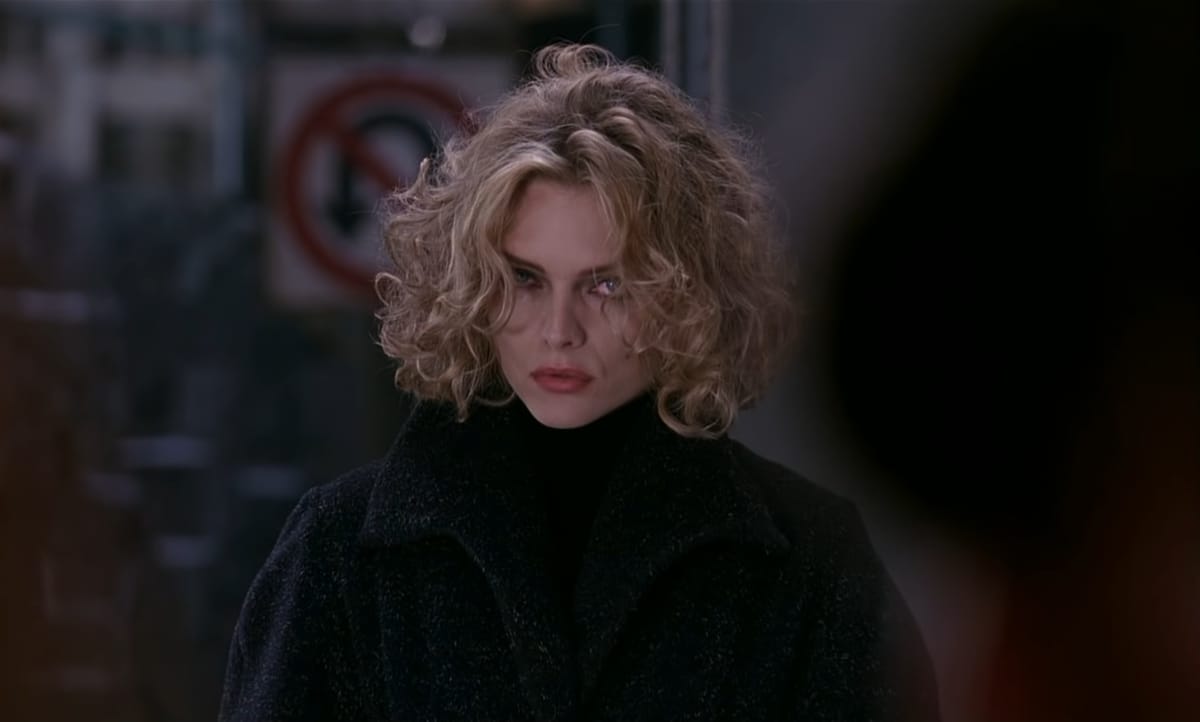
Secondary in prominence to Cobblepot is Selina Kyle, the lowly secretary to Max Shreck. Despite her clumsiness in mannerism and speech, she does exemplify some Catwoman elements before the transition. She has a lot of curiosity and some thrill-seeking tendencies, as shown by her interrupting the board meeting with a suggestion, snooping about her bosses secure files and even admitting it to him directly, and a ferocious face she makes right before she shocks her would-be-clown-kidnapper who was knocked out by Batman. She is killed by Shreck for being too curious about his electrical plant, a ploy that will drain energy from Gotham instead of supplying it, but is resurrected by cats in order to take her revenge. As Catwoman she makes her presence different from the vigilantism of Batman by saving a woman only to berate her, and blows up a Shreck owned store as a way of payback against him. She is mainly in it for the thrill and enjoys the sexual chemistry between herself and Batman, two people in masks playing dress up and running across rooftops. She uses Cobblepot’s horniness and her own sexuality to temporarily team up with him and remove Batman from the picture. This would clear the way for her revenge against Shreck, as Batman would obviously not approve of her wanton destruction of property and her final goal of killing him outright. She isn’t completely devoid of morality, as she does protest to the unnecessary killing of Ms. Gotham, who is similarly portrayed as a ditz as Selina was pre-resurrection. She had a “quirky” apartment, left herself voicemails about forgetting things at the office, and didn’t give Shreck his speech notes before he left. This contrasts with her new self, where she returns to her workplace without fear and a new hairdo and even throws the usually smooth Wayne into stumbling over himself.
Her ultimate goal of killing Shreck is one you can easily get behind, not only because of how he is responsible for her death, but also just because he is a big villain on his own, manipulating and betraying Penguin, just really putting off corporate scum energy. After dying a couple more times and delving into her attraction to Wayne, she finally breaks and is only stopped from gunning down Shreck at the masquerade party by Cobblepot’s interruption. She follows the trail, however, and loses all her “lives” save for one, kissing Shreck with taser and electrical conduit in hand, killing both of them. I appreciate the irony of Shreck wanting the electrical plant to be his legacy and having him die by electrocution.
Selina’s recognition of there being no real recourse for people like Shreck, a sort of stand in for the rich and powerful, as well as Wayne’s own alternative offer being a fantasy that only Wayne can delude himself into living out, is an admirable trait to see carried out as the only logical conclusion and not something to be condemned.
Selina and Bruce are attracted to each other due to their shared duality and dress up, the most physically transforming personas of the bunch. They are compatible because of this, as Bruce mentions the previous film’s love interest, Vicky Vale, couldn’t reconcile his two personas, something that Selina reflects in her own life as Catwoman. There is also a fun near-reveal when the two have to deflect advances while making out on their physical scars from a previous encounter when they were Batman/Catwoman. The ultimate reveal comes from wordplay exchanged as Batman/Catwoman before, inverting their delivery about a mistletoe being deadly if you eat it, and a kiss being even deadlier if you mean it. The delivery comes at a masquerade ball in which Selina and Bruce are the only ones present not wearing masks, as their real chosen identities are the ones when dressed up as Catoman and Batman. It serves as an obvious, but successful, use of this theme of masks/personas in the film.
Michelle Pfeiffer does a great job contrasting Selina pre- and post-resurrection in both her physicality, look, and tone. I especially enjoy her freak out after returning to the apartment the second time, trashing her previous life’s symbols in order to create her new one. She also had to suffer through that costume, one she could only be in for brief periods due to its constraints on her body. Also her looks post-resurrection are just gorgeous.
Selina, Bruce, and Cobblepot all had bad or nonexistent parental figures in life, as Selina’s mom leaves a nagging voicemail for her upon returning from work, Bruce’s died early on and are the cause of his Batman persona, and Cobblepot’s abandoned him in a frozen river. Meanwhile Shreck, the true villain of the film, is actually a good parental figure for his son, Chip. Shreck’s obsession with the electrical plant is in order to leave a legacy for his son and he even convinces Cobblepot to take him instead of Chip when the masquerade ball is interrupted by Penguin coming to claim Shreck’s firstborn.
Shreck, as previously mentioned, is the real villain of the film, manipulating everyone he comes across for his own ends, wiggling his way out of nearly every encounter he has until the woman he killed finally comes face to face with him again. Even then he nearly escapes, only stopped by the supernatural lives of Catwoman and running out of bullets. Shreck is the opposite of Wayne, seen as someone just as rich but with a bent towards immorality, though obviously the argument can be made that Wayne is really no better. No one could better portray this kind of character than Christopher Walken, who just really owns this character and his effortless transition from menacing to beloved public figure. Walken makes it easy to believe Cobblepot would go to him to manage his public persona. His control over his image is best exemplified early on when an argument with the mayor over the plant and his veiled threats are immediately followed by the mayor warmly welcoming him to the stage as if they are great friends. As a frontwardly legitimate businessman, he can’t be confronted by Batman who uses his fists more than anything to combat Gotham’s criminals. Even as Wayne there isn’t much that can be done to oppose Shreck, Bruce just kinda says I’m against it and the mayor is too so I win. Not that it matters as Bruce seems much more interested in combating the more outwardly “evil” circus gang terrorizing Gotham than Shreck who can kill a business partner and throw his secretary out a window without a real second thought. While he may die in the end, and his supposed “legacy” with it, does he really lose? Given his accomplishments throughout life and what was left behind, with his final public act being to give himself in place of his son (there’s that Bible influence again, this situation as an inverse of the Abraham-Isaac story) it doesn’t seem like his public perception would ever change. Killing him was a personal justice for Selina, but a man like him seems incapable of being delivered true justice.
Bruce Wayne is the least interesting character in this movie that bears his name, essentially fading into the background for the benefit of the other characters. As Batman he exists as a reactionary force, to be summoned by a complex series of reflecting mirrors to suppress chaos. He takes some pleasure in beating up the circus people, especially with that comedic image of his smile after attaching cartoon TNT to the large circus guy he can’t instantly knock out with a punch. I also like his Batmobile press that allows it to be pushed upwards for a very slow 180 degree turn, only so it could ignite the afterburner as a show of force against a flame-spewing circus performer. I also love the comedic scene of inputting foes into this electronic batarang to instantly knock each out, only to be caught out of the air by a tiny dog. And of course I enjoyed seeing Michael Keaton as Wayne stumble over his words, standing mouth agape at the entrance of Selina Kyle reborn, nearly giving away his identity as Batman by the mistake of believing they met previously, breaking away the wall between his daytime and nighttime self already when it comes to Selina.
Each character throughout the film is flailing against the world in their own way. Cobblepot attempted revenge against a society that shunned him, Selina against the person and entity who killed her, Bruce against the chaos threatening his city, and Shreck against any and all obstacles between him and his ambition. Each of them with dual faces they struggle to learn or maintain, with Bruce and Selina the most obvious with their costuming. We even get a fun compare and contrast between the two as they change: Bruce selects from a closet of identical torso pieces like a cartoon, whereas Selina struggles to piece hers together as she drives back into town. Cobblepot and Shreck with invisible masks they put on, the latter a mentor of sorts whose betrayal sends Cobblepot down his road to destruction, lashing out when he is abandoned just as he was when a baby. For all of these reasons, as well as Elfman’s excellent score, the sets, and the costumes/makeup, Batman Returns remains a film I look forward to watching every December.