Strange New Worlds: In Spirit, Not in Detail
If you will allow me this indulgence, I want to talk about Star Trek
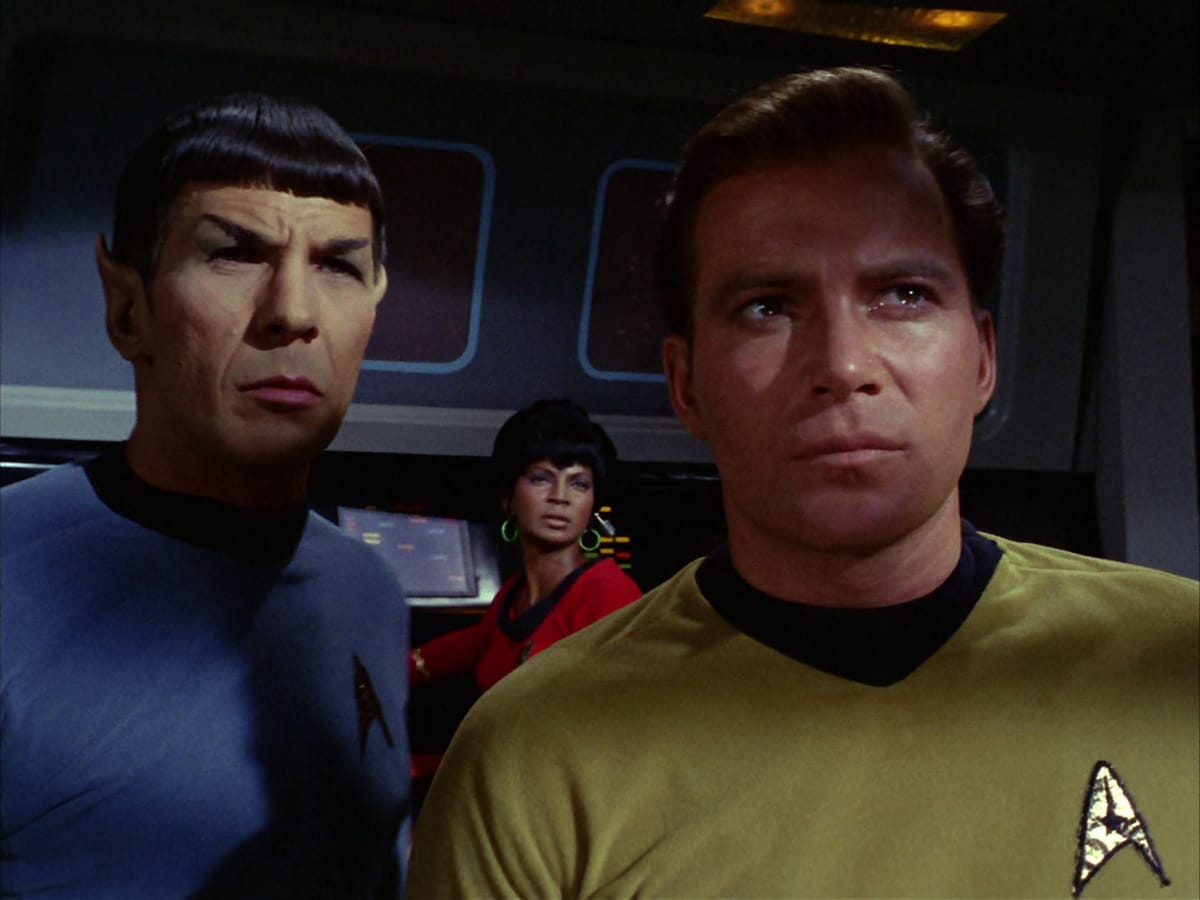
Star Trek: Strange New Worlds is a successor to The Original Series in spirit, not in detail.
By detail, I mean that if Strange New Worlds were to end exactly where The Original Series begins, it would be jarring due to the set design, the visual effects, and the actors all not matching up to their original counterparts, not only in looks, but also in how they act and speak. Strange New Worlds is not as beset by modern writing as other works are, but is still significantly different from The Original Series’ writing. The reason, of course, is that you will never be able to recapture The Original Series. You can't go back to the 1960s and shoot on the same sound stages, write like they did, or act like they did. And that is okay. The Original Series is quite silly when viewed today, but played totally straight at the time which gives it its immense charm. Nowadays writing for television and films can’t help but feel too self-aware and in on the joke.
By spirit, I mean that a majority of episodes of Strange New Worlds have a premise and plot that could very easily have been from The Original Series. The crew must steal the Enterprise to save one of their own, Spock becomes fully human and must perform a Vulcan ritual, a crew member is placed on trial, a big asteroid is going to destroy a planet, a space sickness must be cured before the ship blows up from the resulting behavior, a time travel adventure with some romance and tragedy, a world’s culture has a shocking cost for its peace, and even an excellent reprise of “Balance of Terror,” swapping out James T. Kirk for Christopher Pike to teach a lesson on who is required in the captain’s chair for that scenario. Episodes that came to mind when watching Strange New Worlds include: “Court Martial”, “The Paradise Syndrome,” “The Naked Time,” “The Enemy Within1,” “A Taste of Armageddon,” “The City on the Edge of Forever,” “The Devil in the Dark,” “The Conscience of the King,” “Star Trek III: The Search for Spock,” and even some The Next Generation episodes/films such as “The Drumhead2,” “Qpid,” “First Contact,” “The Measure of a Man,” and most significantly for Strange New Worlds: ending Season 2 on a cliffhanger that requires waiting for the still unreleased-as-of-this-writing Season 3 to be resolved.
I'm very happy with Strange New Worlds having the same spirit of The Original Series, even if it is going to do certain things that I don't agree with. One such example is introducing the Gorn as this unknowable and threatening presence alongside Klingon (here reduced more to comedic relief) and Romulans. Occasionally Strange New Worlds overtly relies on iconography, terms, facts, or individuals from The Original Series that doesn't feel right. The Gorn were a one-off. It was one individual Gorn that Kirk fought in “Arena,” an episode that has very funny fighting choreography and takes place in the Vasquez Formation that everyone uses as an alien landscape. The Gorn showed up once as a one-off thing for Kirk to battle in order to test his character. To test whether or not he would kill another being simply because a force larger than him was forcing his hand. And he doesn't. He refuses. Even knowing the Gorn would not have hesitated were the roles reversed, even if it will cost him the Enterprise, he refuses. “Arena” is such a great episode that tests Kirk’s character. Therefore, to bring back the Gorn to be this xenomorph imitation of space-faring alpha demons, it makes me question why couldn't you come up with something yourself? You should have just tried to invent something new. Consistently the problem with “legacy sequels” is that they rely solely on the recognizable portions of what they are following up on instead of creating new things. They live or die by whether or not they're able to introduce new ideas to the fiction. If they're not then we're just wasting our time.
“One-off” is the essence of the entirety of The Original Series, in that no plot extended beyond the length of its own episode. Strange New Worlds largely sticks to this spirit in it’s “A” plotting in that there is a separate problem introduced and solved each episode with no carryover forward. However characters will be affected by events, carry baggage, or solve a problem introduced in a separate episode. This way you do not repeat scenarios such as Captain Jean Luc Picard’s experiences in “The Inner Light3,” or, “Chain of Command Part I & II,” which should have radically altered the character going forward. The only such follow up given was “Family4” which directly addressed Picard’s experience in “The Best of Both Worlds Part I & II.” This change keeps from isolating every single episode from each other while still retaining the joyful approach of, “What is the gang going to get up to in this episode?”
Spiritual succession includes not just plot but performances. Ethan Peck as Spock is not Leonard Nimoy as Spock, and that is okay. Nimoy was a once-in-a-lifetime actor and he portrayed Spock in his way, and you will never have that again. When Peck acts in ways that are incongruous to the way Nimoy acted it is acceptable because this is not Nimoy or a Nimoy impersonation. Due to the Kelvin movies trying too much to imitate Leonard Nimoy–it is especially telling that they involved Nimoy himself in all three of them–it made the parts where Zachary Quinto wasn't acting like Spock stand out all the more. This is why we make fun of the ending of Into Darkness, where Spock goes crazy and beats up Khan while screaming. If Quinto had put his own interpretation of Spock on and not imitated Nimoy, this incongruity might not have stuck out as much because it is true to Quinto’s Spock, not Nimoy’s. This is why Ethan Peck is very good as Spock, he is not imitating Nimoy a majority of the time5. Times where he acts out in such a way that we don't believe Nimoy would have acted, it becomes much easier to accept.
Much the same with Kirk. William Shatner is a once-in-a-lifetime actor. There are imitations and they are amusing but not fit for a television show. Paul Wesley instead plays Kirk in the same spirit, with a deep care for his crewmates and a willingness to take risks and stand his ground, and not in the specific details, as in performing a Shatner impression. Anson Mount as Captain Pike is not very reflective of the Captain Pike that we see in the original pilot episode, “The Cage6.” We only got that one pilot with Jeffrey Hunter as Pike, playing a captain who was under a lot of duress, the long standing pressures of captaining, and beginning to fall under it all. Hunter also tragically passed away a few years after the original pilot was completed, most likely due to a separate on-set head injury. Despite being the first Captain with nothing to draw from, Hunter did a superb job playing Pike in “The Cage,” which would be repurposed into the two parter “The Menagerie,” an episode which haunts Mount’s Pike throughout the first season of Strange New Worlds.
Christine Chapel (played by Majel Barrett in The Original Series but best recognized as Lwaxana Troi, Deanna’s mother, in The Next Generation, and funnily enough, the original Number One in “The Cage”) appears here played by Jess Bush. Her crush on Spock, which was touched upon in The Original Series, is expounded on here. This expansion does not read as desperate as introducing the Gorn as a larger presence does. Instead it reads as a continual well of tragedy to pull from as a will-they won’t-they whose final answer is already known. Parallel to the tragedy of Pike’s fate, Chapel and Spock’s relationship potential also has a known end. Compounding that haunting of one’s fate, Dan Jeannotte as George Samuel "Sam" Kirk plays a character whose grim end is known by the viewer but not the character7. Nyota Uhura appears here played by Celia Rose Gooding and is young, exuberant, a little unsure of her ability at times, and full of wonder. She gets much more to do than Nichelle Nichols was able to with the character, which works in her favor when it comes to being more free to offer her interpretation of this familiar character. I think she is my favorite interpretation of the returning characters. From this grouping, Rebecca Romijn as Una Chin-Riley (Number One) is most difficult to read. She is fairly plain and her character’s appearance in “The Cage” is so slight that Romijn is free to play her anyway she pleases, I just don’t have much of an imprint of who she is in my memory other than Number One.
As mentioned before, legacy sequels (in this case prequel) live or die based on the new fiction they introduce. From the new cast introductions we have Christina Chong as La'an Noonien-Singh, Worf in human form in terms of eagerness for and capability of violence. Her relation to the infamous Khan Noonien-Singh seems mostly unwarranted save for one time travel episode involving a “would you kill baby Hitler?” scenario. Melissa Navia as Erica Ortegas is an even more joyful analogue of Sulu. Babs Olusanmokun as Joseph M'Benga feels entirely new and has several skeletons in his closet that get brought to light. Carol Kane as Pelia is a more eccentric Guinan. It is unfortunate that Bruce Horak as Hemmer is not brought forward as he was the only significantly alien crewmember with great makeup effects. Horak does get to return in Season 2 albeit as a different character with a similar amount of makeup work as a one-off.
I have a lot of affection for Star Trek, and Strange New Worlds is the only modern permutation I enjoy and look forward to. It is The Original Series in that it is pulling from the same characters, the same fiction, the same touchstones but it is very much its own thing. It is different and that's okay because it retains the spirit. It would not be able to retain the details. We would not be able to replicate the production of The Original Series in 2025. Strange New Worlds makes the smart decision of not trying because it would not work. And because it doesn't and instead focuses on retaining the spirit of that show, it succeeds. Lastly, given they take the title from the opening monologue of The Original Series they should also just bring back the theme song. Just copy-paste. I think that would be excellent.
I also must state my love of the tumblr post I saw long ago that summed up Star Trek as a fiction in which we have invented instantaneous molecular travel and must then come up with an infinite number of ways why it doesn’t work in this instance. ↩
I have been thinking of a list in my head of unexpected Star Trek recommendations. This episode, the one where Picard gives a big monologue about ethics, is the episode you show your friend who really loves The West Wing. “The Omega Glory” wherein Kirk recites the Declaration of Independence is best watched on the 4th of July. “Turnabout Intruder,” wherein Kirk’s body is inhabited by a woman, and therefore unfit to command, is what you show your misogynist friend. ↩
When combined with “The Offspring” and “All Good Things…” these episodes elevate The Next Generation to GOAT status. ↩
No, I have still not forgiven Star Trek: Generations for callously killing the titular family from this episode off-screen. ↩
The single 1:1 imitation I can recall is an excellent eyebrow raise during SNW’s “A Quality of Mercy,” which is fitting because the episode is a reprise of TOS’ “Balance of Terror,” in which Nimoy performs the same raising. ↩
Despite being the first filmed episode, rejected by the network, and leading to the recasting and reworking that resulted in the classic that is The Original Series, “The Cage” remains one of the finest Star Trek episodes. ↩
Entirely separate from the fiction: I understand the logistics of the why but I thought it would have been absolutely hilarious if they mirrored this character’s appearance in The Original Series by having both Sam and James Kirk played by the same actor as in “Operation -- Annihilate!” ↩