The Legend of Zelda: The Minish Cap Critique
discordance in play and kitsch in narrative
You can find a video version of this write up here.
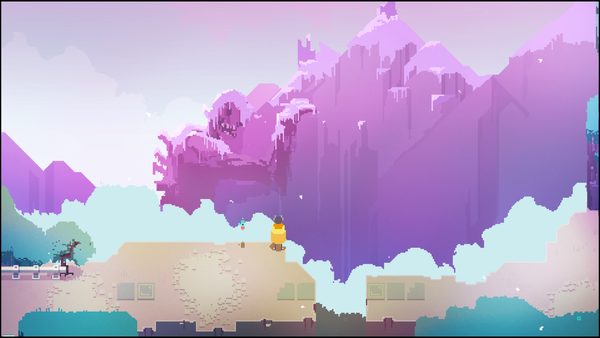
Centered in a diverse realm of forests and mountains, occupied by a peaceful people, is the kingdom of Hyrule. Despite presenting as natural as the swamps and cliffs and rivers that run throughout this land, this kingdom, and the soil itself, were anything but organically created. All that exists serves the player and has been shaped just so that she may fit each piece into its proper position and empty it of its secrets. Artifice interrupts the believability of this world being natural and is discordant with Hyrule as a place living in harmony with, and as we find out, on top of, nature.
This series’ origins are in Miyamoto’s early memories of the Japanese countryside near Kobe1. Hyrule attempts to capture the majesty and wonder of a child exploring the outdoors. Due to the cramped configuration of Minish Cap’s overworld, this majesty is not as present as it is in Breath of the Wild. Dense and criss crossing pathways make up nearly every screen, teasing their temporary inaccessibility. Keys are found in their familiar and toolset form: a wand that flips objects, a pair of flippers for swimming, shoes to run across swampy water. Locked doors litter the world: rocks that can fill a hole to provide a shortcut once you have accessed the other side, stationary whirlwinds that let you float across gaps, pads that allow you to become tiny right where it is required. Presenting as naturalistic yet plainly artificial in layout. Two instruments following different time signatures. A harsh noise underneath it all. Tinnitus in the ear.
The main pleasure of the game is in solving its many puzzles. Accumulating keys to unlock blockages throughout the overworld and the crescendo of dungeons feeding you audio clips as reward for each successful answer. Solutions that eluded me were because of a lack of communication by the game on what is allowable. A seedling is to be moved into its proper place while tiny, however the seed is several times larger than yourself and no previous experience as a Minish had told me I could pick up an object that large. The Ocarina allows you to travel to points you have activated throughout the land, including one in Lake Hylia that you have not interacted with but must visit. The three-part final boss fight had me swapping through every item to see what would wound it, which led me to pulling up a guide to be free of frustration. I will also mention it is unnecessarily mean to hide away faster charging for your split gauge behind a kinstone2 accessed waterfall. Separately, there was a difficulty with a display of depth that made the Palace of Winds more tedious than pleasurable to clear, along with a split gauge focused boss when I still had the slower charge.
These instances only stand out due to the majority of A to B movement, whether it be the room to room order of dungeons or the pathway to the next one in the overworld, are so much better at presenting a problem whose solution is promptly intuited and implemented. So much of it is unconsciously performed, the ideal and most pleasing momentum. This balance of friction, as well as the theming and its adherence to the Zelda spirit, makes it easy to forget it was not Nintendo but Capcom who developed this entry. Minish Cap is the finale of the partnership, though Director Hidemaro Fujibayashi would graduate to becoming director for the major Nintendo developed Zelda titles onward. Nintendo’s licensing was a lucrative deal: should Capcom fail, their work could be written off as bastard children a la Animation Magic’s Phillip’s CD-i games. If they succeeded, as they did, the works could easily be consumed into the Nintendo blob, as without the Capcom logo appearing upon boot-up, they give no indication within or out of the game that the Big N themselves did not create this. The Picori, blissfully toiling out of sight to help and benefit their larger neighbors, can be read as this team, with many around from Oracle of Ages/Seasons staying through to Minish Cap.
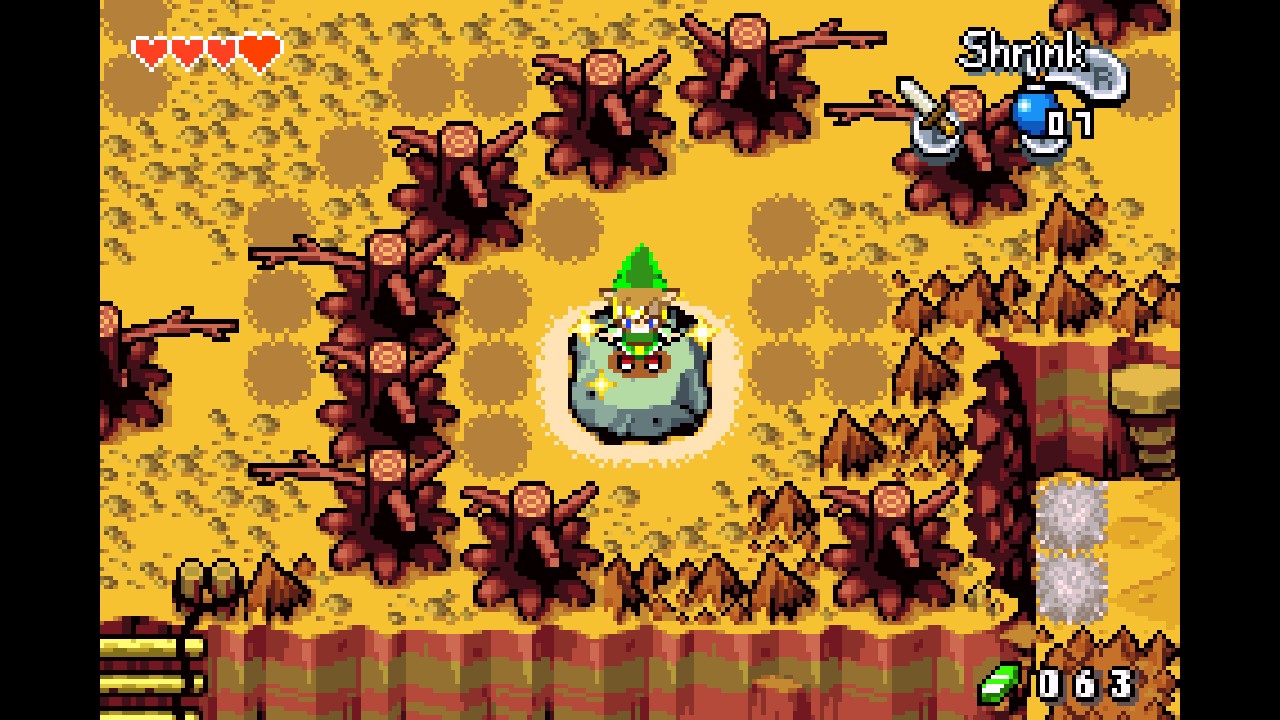
The Minish, or Picori, are tiny elf-like people living alongside Hylians. By alongside I mean either out of sight in the forests, mountains, and other natural landscapes of the world or within the walls and ceilings of the Hylian’s homes. They represent truly living as one with nature and humanity, taking the detritus from both and shaping it into their homes. The Picori are a benevolent people who derive pleasure from aiding Hylian’s in their endeavors. This is most explicitly shown with the shoemaker, who comments on how even when he naps shoes are bizarrely created and worked on while he sleeps and only lacks his “final touches” to render them complete. The legend of this Zelda title is the Picori’s existence, only visible to a child’s eyes, out of innocence or curiosity or naivety. The villain is not Ganon or Ganondorf but Vaati, a former Picori wizarding apprentice who stole a magic hat that grants wishes and became the most powerful sorcerer. He then set his sights on the fabled power of light within a chest sealed long ago by the Picori blade. Vaati turns Princess Zelda to stone, unleashes the evils residing within, breaks the sword, and disappears. Link is tasked with reforging the blade and sealing the evil once again.
My problem playing and writing about Nintendo games is that they are toys to be played with. Rarely are they narratively rich in-and-of themselves. I struggle to speak purely about a game’s mechanics and favor narrative endeavors. Why is Vaati evil? Why does he crave power and betray his former master? Why is he so different from every other Picori we see and talk to? Why is he othered by his skin color? He just is and does. I find Link and Zelda frustratingly blank canvases upon which fans may draw whatever they desire onto them. The miniscule characterization you get is from Zelda, as Link is nearly as empty a vessel as Gordon Freeman. Link’s only saving graces are the animations that exude his cartoony character when he is tugging on a mushroom, zooming on a mine cart, or falling from a great height. Zelda is a childhood friend of Link’s, implying a storied relationship between the two, and is quite excited by the events of the annual Picori festival. There is also affection for Link, retrieving him from the Smith’s and gifting him a shield from her raffle winnings. Then she is promptly petrified so that Link can resume his usual business of setting things back to normal. This is conservatism present in a majority of fiction: an aberration in the currently understood balance of power that must be cleansed.
Hyrule is a land we long to live in ourselves, a fantasy of our own past that never existed. The feeling is familiar to me not regarding the Zelda series, but in the works of Studio Ghibli. Specifically, here we can call upon Princess Mononoke. Industrialization in the name of forward progress has its consequences spin out and affect a rural village in a very consequential way. Mononoke asks the question of “wouldn’t it be nice to exist within this space?” and answers, “yes but that’s not happening anymore. It is being eaten.” The consequences of industrialization are far-reaching beyond the wildest imagination of those behind it. A gun fired hastens the decline of a banished tribe leagues away. At the same time, Mononoke also taps into nostalgia for a memory that did not happen, a longing for a place we never visited. That mournful feeling is a sharper emotional reaction than the oblivion of unthinking playtime, and one I prefer. Link’s Awakening from within the series is another example: Marin is not relegated to the bookends of the game like Zelda and is instead much more present and fleshed out. The finale’s sorrowful reveal therefore earns it much more affection than Minish Cap’s kitsch.
Vaati’s attack reveals a people who cannot save themselves, who require an outside power in past and present to be saved. A slight alteration to the story I would have liked: Hyrule’s expansion in the interval years is destructive to the Picori, inadvertently harming their once and future saviors. Thinking further on the Picori I morbidly observed they would not survive an industrial revolution. Not that it would ever happen. Hyrule is a land trapped in time, a fantasy of knights and magic and divine swords and wild monsters and princesses, a royal family with an actual divine right of kings. This King gets a spell cast on him by Vaati and becomes bad, but it is not that having an absolute monarchy is bad, it is just that the current good king is being influenced by an evil person.
I became fixated on this because I prefer my fiction to be honest, even in fantasy. I am bothered by the lack of imagination, similar to past writing about Dishonored. We have unlimited possibilities to create and instead we are retelling the same basic story again and again. Breath of the Wild commits many of the same sins in its characters and plot but does not feel as discordant, thanks to extended periods of rest between the puzzle notes. Shrines separate the overt puzzles from the overworld, and while divine beasts lacked the crescendo of proper dungeons they were in tune with the fiction. Korok’s cover the terrain, but as playful spirits at home everywhere.
This does not mean I dislike Minish Cap, it is just a good game instead of a worthwhile one. It is more of a clarifying lens for why I liked Breath of the Wild. As a handheld title I can not hold its condensed nature against it too heavily. Most are fine with Zelda and Nintendo games as toys that they play with and put away once they are finished, as simplistic affairs for children. I wanted more. I continue to want more. It will never cease.
When I was younger, I grew up in the countryside of Japan. And what that meant was I spent a lot of my time playing in the rice paddies and exploring the hillsides and having fun outdoors. When I got into the upper elementary school ages — that was when I really got into hiking and mountain climbing. There’s a place near Kobe where there’s a mountain, and you climb the mountain, and there’s a big lake near the top of it. We had gone on this hiking trip and climbed up the mountain, and I was so amazed — it was the first time I had ever experienced hiking up this mountain and seeing this big lake at the top. And I drew on that inspiration when we were working on the Legend of Zelda game and we were creating this grand outdoor adventure where you go through these narrowed confined spaces and come upon this great lake. And so it was around that time that I really began to start drawing on my experiences as a child and bringing that into game development. (NPR Staff, “Q&A;: Shigeru Miyamoto On The Origins Of Nintendo’s Famous Characters.” NPR.com, 2015.) ↩
Kinstones are puzzle pieces doled out randomly by cutting bushes and the like, or found in chests or rewarded by individuals. You can take these and fuse them with a matching piece with individuals throughout the world who display a thought bubble when you run up against them. ↩