Violence in Prototype
Thinking about victims of all kinds
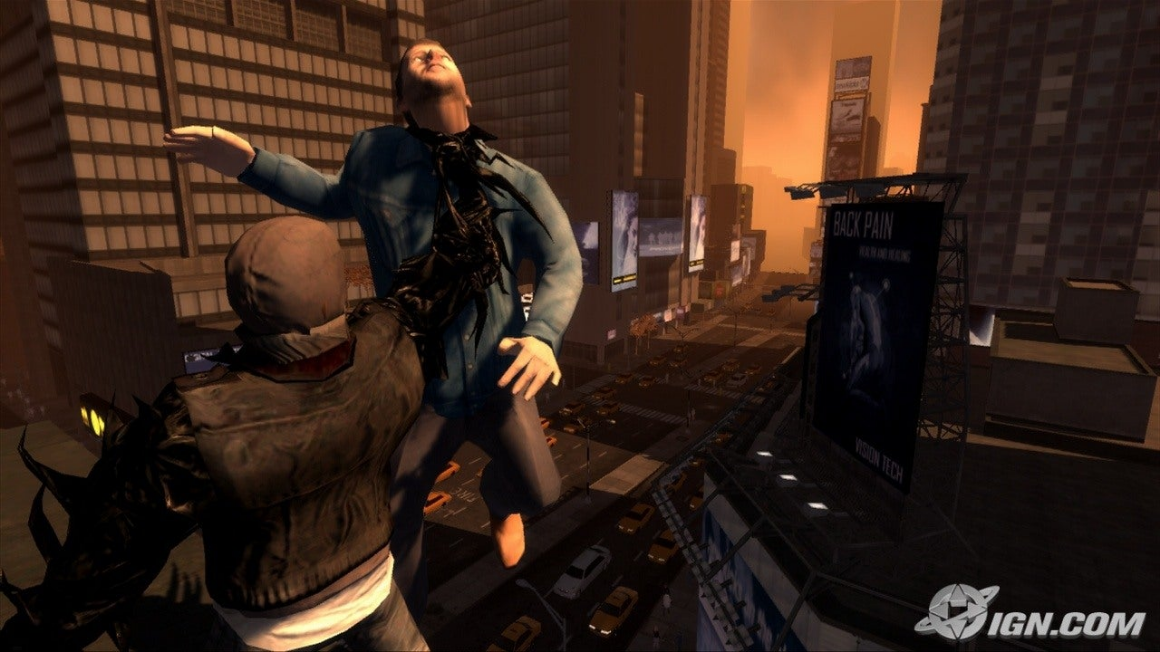
I know what you are thinking: Really? The violence in Prototype is noteworthy? Isn’t it just juvenile, over-the-top gore? And yes, you are right, it is. However, when you stop to really observe what you are doing to other’s bodies in the game, it does become unsettling both in the efficiency at which you are committing the violence and the way the game offers up these bodies as detritus for the human shredder that is the player.
Prototype is regarded as an update to developer Radical Entertainment’s previous open world game The Incredible Hulk: Ultimate Destruction from 2005. Watching gameplay from Ultimate Destruction you can immediately see the truth behind that. Freed from the restrictions of a licensed Marvel game, Radical Entertainment was able to compensate for the bloodless violence of The Incredible Hulk with a game centered on the brutal destruction and absorption of human bodies.
Alex Mercer, the game’s amnesiac protagonist, is one host of a virus that is currently spreading and creating monsters throughout Manhattan. Mercer is a monster, but retains some semblance of humanity in that he can speak and isn’t purely driven by the base desire of killing everything he sees, most of the time. Mercer can turn his limbs into weapons, embody himself in thick armor, and shapeshift into the form of his most recently ingested human. These devourings are very the epitome of Prototype’s violence. Alex will grab the individual, throw them into the ground and proceed to punch their body into mush as his own begins to absorb the gore spewing out. Regaining sections of your health bar require consuming the mass of others, and each weapon available to morph your body into comes with a few unique animations showcasing Mercer cutting bodies in two, crushing heads, and generally wreaking complete and total destruction of another’s body for his own benefit.
This violence is not that out of place amongst the breadth of video games released, even contemporaneously. Reid McCarter writing about the Robocop: Rogue City, describes the phenomena as, “Videogame violence is so commonplace—so, to put it properly, unremarkable—that it doesn’t warrant much description. The medium’s critics, as a whole, are unlikely to comment on it any more unless, maybe, a game’s brutality is particularly bold. It’s just a matter of fact that videogames are violent. Bullets pulp heads, swords sever limbs, and nobody is particularly moved by the routine bloodletting.” It circles back to my opening in that writing about the violence in Prototype seems unremarkable. The game does not invite the player to pause and ruminate on their actions. When you do, you may begin to feel a little sick at how thoughtlessly you are ending lives.
Unlike most games, which will cover the violence with cartoonishly evil or non-human bodies to be destroyed, Prototype fills its open world of Manhattan with regular, normal, human beings. Due to limitations of the hardware at the time, the human beings are rigidly mechanical and synchronistic in their appearance and animations, but the sheer amount of them is drastically different from the loneliness of a place like Liberty City, despite the immense amount of money poured into rendering New York City through the Grand Theft Auto lens. This number means the player will always have body mass on hand to both replenish their health and also to gleefully dispatch and dismember using the various killing tools afforded by the upgrade shop. Trophies such as “The Butcher” which task the player to “Kill 50 characters in 5 seconds,” and especially “Speed Bumps” where you are required to “Run over 500 characters in a single tank,” reveal the glee behind Radical offering up this number of bodies to the player, beckoning them to enact violence upon them.
Once you begin to stop and think, to (stay with me here) empathize with the people you are enacting this violence upon, is where I begin to really feel the effect of the violence. Manhattan has been quarantined, a military force named Blackwatch is violently attempting to contain the outbreak of a rampant virus that turns people into zombies by way of 28 Weeks Later or incubates them in water towers, transforming them into much more imposing and bestial forms. Those remaining in Manhattan have no escape beside death. While there is a break in logic in why would people be walking about a city where just a block away the sky has turned red and zombies consume everyone living, I also think as we continually approach the apocalypse I have found that people will continue to live without making any changes. What if I was caught in the net of this quarantine? How would I protect my family? What power do I have against Mercer consuming my flesh to replenish his own? And it is not like this powerlessness or empathy does not exist in our lives. I’ve written about digital bodies before in relation to the ongoing genocide in Gaza, though most recently my ruminations have been about the victims of Baltimore's Francis Scott Key Bridge collapse. On the feeling of helplessness when a bridge is removed from below you, and the lack of any justice as the fault lies in the excesses of global economies demanding more and more despite the foundations being built for only so much capacity.
Radical Entertainment eventually became a victim itself. After the enormous sales expectations it was saddled with by its parent company were not met, it was consumed into the monster that is Activision and eventually lost all semblance of identity and substance in manpower. I have always been doubtful of video games as a teacher of empathy, but I do believe that encouraging individuals to stop and think about the connections between different aspects of them, about Radical Entertainment becoming another “support studio” for a larger entity, about the empty feeling of helplessness of those being swallowed by circumstances beyond their control, might help us become better and work towards a better future than the one I fear.