Reading Games Writing: This Sacred Body / This Bloody Mind by Artemis Octavio

While reading Artemis’ writing on Zero Parades: For Dead Spies, I was struck by how their major problem with Disco Elysium is the reason I love it so. It provoked and pushed me to further interrogate why I feel that way. I have not played Zero Parades (yet) and so this will be limited to the Disco Elysium side of the coin, one whose face has appeared time and time again since its release and continues to overshadow every writing about its sequel, so I understand if this is a trite subject for the reader.
In regards to whether or not Disco Elysium is a communist videogame, I do not believe a work needs to be didactic to qualify as one. I do understand the snags many had regarding how the game pushes forward a position of post-irony. Measurehead, the casting of Chapo Trap House and their adjacents as the original voices, and the ability to engage in fascistic dialogue choices and thoughts. However, when it comes to the game’s relationship with communism, more accurately the in-fictional analogue Mazovianism, the game has an overwhelming romantic love for the ideology born out of its possibilities and its failure.
The district of Martinaise, in which the entirety of the game takes place, resides within the city of Revachol. Fifty years ago the Coalition of Nations came and destroyed the communistic Antecentennial Revolution that was building momentum within Revachol and Graad. Joyce Messier is an ultraliberal, betrayer of the revolution, and a representative of The Wild Pines Group, a corporation whose most recent revenue was 20 billion Reál. Despite her high status, Joyce captures that wistfulness I find throughout Martinaise.
"I've no right to be dissatisfied," she shakes her head. "This shirt is Barbara Muskova. This raincoat is impervious to rain and is guaranteed for a hundred years, my daughters will wear it. No, it's just..." She looks at the crumbling tenements, paint flecking from the stone… Her voice is almost wistful. "We could have had so much *more*. Every one of us – if only we'd played it right."
"Past?" She cocks her head to one side. "That's what Dobreva, the leader of the communards said, before she got a bullet in her head. Don't get me wrong..." There's sadness in her voice… "Capital *is* finished. But understand this – its end won't *free* anyone. It will only lead to more suffering."
You can hear it in the horns of British Sea Power’s “Instrument of Surrender" which plays anytime you are walking about Martinaise. You can hear it in Kim’s voice when you find a cache of old Belle-Magrave rifles. You can hear it in Lena, The Cryptozoologist’s Wife’s dialogue about the defeat that came after “the people of this archipelago tried to build something new, something *different*.” You can hear it in Visual Calculus’ reconstructing of the firing squad in the bullet ridden wall. You can hear it firsthand from someone who was present for the failed revolution.
The Deserter: "Nothing changed. Not in the *material base*, not in the *hegemony*, there was no uprising. Just words... The Union fizzled, sogged. Nothing came of it. Nothing."
The Deserter – "You think I haven't seen people die? It's all I've seen them do. Fuck and die – all the other plans we had. To love. To colonize the pale. It's all fucked..."
Volition – He's not okay. This is just another black day, in a row of black days – something *strange* is keeping him together, making him endure...
Conceptualization – ...an idea. Told to him by grown ups, from radio towers and leaflets, in beautiful print when he was still a teenager: everything is possible. If we fight.
Pain Threshold – And then he lost. So did they all.
There was an opportunity fifty years ago for substantial change to occur within the world of Disco Elysium just as there was an opportunity a hundred years ago for substantial change to occur within our own world. A revolution occurred, and outside powers came and helped kill it twice.
China Miéville's October: The Story of the Russian Revolution recounts February to October of 1917 in the city-state of Petrograd. It is the story of constant elections determining the body of the Soviet: Bolsheviks, Mensheviks, SRs, Left SRs, Kadets, and various independents, in the lead up to the usurpation of the dual power coalition and the ascendency of communism as the formation of state government. It was short lived. Various factors, internal and external, caused its change into Stalinism, which eventually died/was killed and rotted into an authoritarian republic.
From 1918 to 1921, the Bolsheviks must fight several counter-revolutionary or ‘White’ forces, backed, assisted and armed by foreign powers. By 1919, Russian territory is occupied by American, French, British, Japanese, German, Serbian and Polish troops. Socialism, the red bacillus, is more irksome to the Americans, British and French than are their wartime foes.
Reading this during and immediately following my first playthrough of Disco Elysium in 2019, it is impossible for me to disconnect the feelings the writers of Disco Elysium have regarding the in-game revolution from ours. The melancholy feeling of there once being a chance at great change, at a worldwide revolution that could have ushered in a better world than what we are currently living, and a hope for its resurgence. This is why Disco Elysium has an immense romantic love for communism, despite its layer of irony, despite its perceived impossibility, both of which are personified in Steban, the Student Communist.
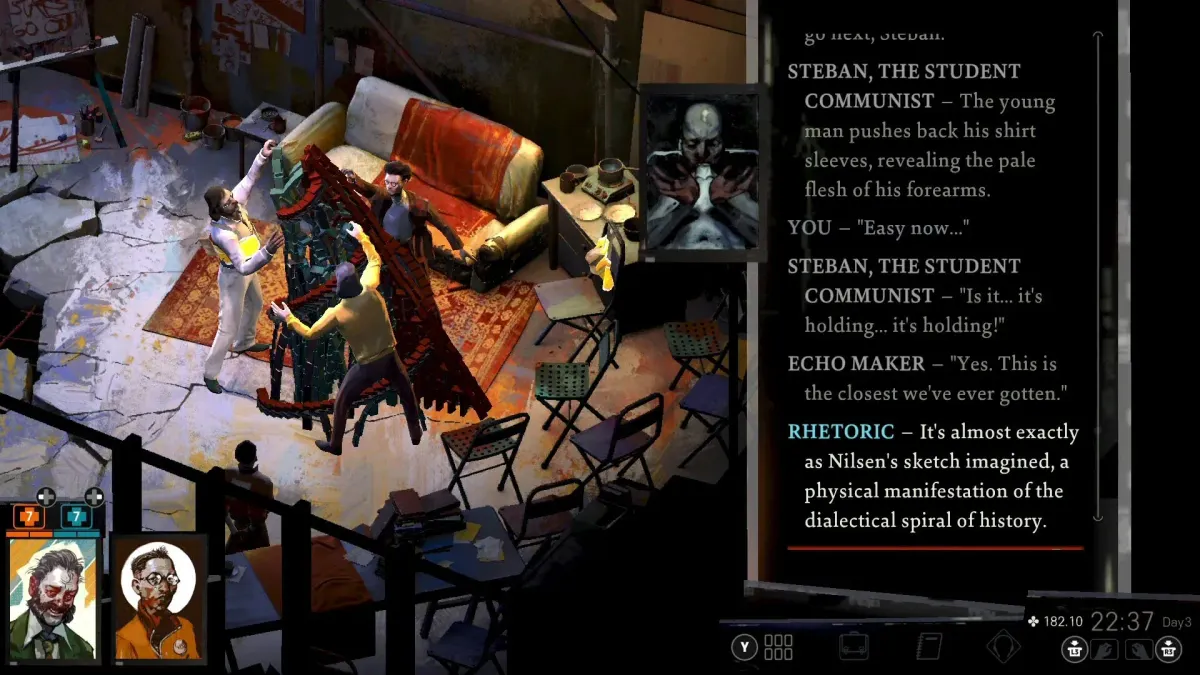
Should you succeed passing the various checks while speaking with Steban you get to ask him the question of what the point of communism is given its current preference for theories and how often its practitioners die or are killed. Steban’s answer is, “Communism doesn't dangle any promises of eternal bliss or reward. The only promise it offers is that the future can be better than the past, if we're willing to work and fight and die for it.” Steban continues, “‘I guess you could say we believe it *because it's impossible*.’ He looks at the scattered matchboxes on the ground. ‘It's our way of saying we refuse to accept that the world has to remain... like this…’” Those matchboxes are another symbol of the hope found with engaging. There is a chance you can join Steban and his club partner in building what should be impossible out of the matchboxes.
Rhetoric – There, in the middle of the floor, the winding spire quivers with an improbable energy...
Kim Kitsuragi – "This is impossible, right? There's no way it's really staying up like that..."
Artemis describes their major problem with Disco Elysium, by way of Zero Parades’ reproduction, as being a “hopeless game.” The failure of the revolution in Disco Elysium is a tragedy that colors everything that occurs in current day Revachol. As Joyce puts it, “Our time is a shadow cast by that day." As Artemis puts it, “[bad ideological power] has already won the war,” here we are living amongst the wreckage doing what we can.
I love tragedy. I love to occupy that feeling of sadness and emptiness that a failure occurred and there is nothing the character on-screen or you as the viewer can do to solve it or make it better. Its cathartic, the way singing along to breakup songs or suicide ideations are even though I’m in a happy marriage and it has been years since any thought of self harm has occurred. It is not permanent or debilitating, but dipping into melancholy occasionally as a reminder of the fullness of life. It is a little bit of sense memory, maybe a little bit of guilt that I should feel this way as karmic repayment of decisions made earlier in life, maybe a little of pouring out what I have been bottling up. It is the tragic works that have spoken to me on a deeper level than anything else, a connection made with loss, the emptiness where there was once life. This is a feeling Harry is very familiar with personally but whose pain is overshadowed by the larger loss surrounding him in Martinaise, the one that has stuck to me many years after first encountering it because it strongly captures and represents my own feelings regarding the brief revolutionary period we had so long ago.
A quote shared from Colin Spacetwink within Artemis’ writing reads as a problem with scope. Disco Elysium is a city block game, not a traditional RPG spread across the world in which the player character radically upsets the balance of power. It is not interested in that. It is interested in the local, the individual. An overwhelming majority of people you see you can engage with and talk to and learn about and learn about the greater fiction from their filtered viewpoints. Colin takes umbrage that the “dream of enduring change is localized to the police station that Harry reports to.” Again, it is unreasonable to hold the game accountable for failing to have Harry restart the Antecentennial Revolution and murdering the leadership of the Coalition within the scope of a city block and the length of one week. In the introduction of the communist thought cabinet entry, Rhetoric states that “0.0001% of communism has been built,” “You must seek out your revolutionary brothers and sisters. Find out how much communism they've built. Then, together, maybe you'll be able to build as much as 0.0002% of communism.” I can see why some would perceive this as belittling, but I see it as a serious assertion of what has been done and what you are capable of doing within the scope of the game. Harry cannot overturn decades of political machinations, but he can do more than just, “arrest someone.”
Another stumbling point for many is Harry’s role as a cop. A majority of criticisms come from those who view police work through the lens of the American police force, whereas Disco Elysium comes from Estonians, whose country experienced a brief independence of 22 years before being forcibly annexed into the Soviet Union for over half a century. Learning about the Revachol Citizens Militia you reveals they are a very different type of police force. They are made up of volunteers, whose salaries are not paid by taxation but donation. They keep the peace in place of the Coalition, whose failure to bring order during the postrevolutionary decade allowed the people of Revachol to bring it about and maintain it from within. As Joyce describes it, the RCM operates in, “the twilight of international law.” RCM members mainly penalize by imposing fines of up to 1,000 Reál, and their power is largely a projection. Station call slips are preferred over outright arrests, and most cases go unsolved due to lack of manpower and funding. Should the RCM fail outright, the Coalition would be more than willing to step in to place their boot on the peoples necks. In a conversation unrelated to the RCM Kim shares that, “manufacturing and sale of automatic rifles was curtailed after the Revolution. The destructive power of such tools proved to be... too much. We do need to retain some humanity in this world,” further distancing itself from the all encompassing “American” lens that dominates cultural criticism.
Jean Vicquemare’s debriefing at the end of the game covers all that Harry did, which can include: shooting the mercenaries at the tribunal (you can only reduce the potential dead to a minimum of six), discover the Claire’s are responsible for the murder of the previous union head, move the kids from a tent on melting ice into a church-turned-ravehouse, and most importantly, discovered the body of the working class husband. This task first comes to you preternaturally when first talking to the working class woman. Harry fixates on the possibility that her husband is missing, convincing her to allow you to investigate his whereabouts. You do eventually find him, dead on the boardwalk for at least two days. You break the news to his wife in their apartment in the most touching scene within the game.
Working Class Woman – "Oh." She touches her neck, eyes pale like pearls in seawater. "Oh," she says again, "But he was just..." She looks at the kitchen table, where two cigarette butts are still in the tray.
Empathy – But he was just here. Alive.
This conversation is something only the RCM is truly capable of handling with the necessary tact. Without Kim and Harry it would be very likely the body would rot as it already has for two days, disposed of without comment by the Hardie boys and leaving Billie, the wife, with no closure. Within Disco Elysium, you cannot bring about economic prosperity to this city block. But you can offer closure regarding a missing husband, which is more intimate and touching than the typical fantasy of RPGs.